On the roads of New Zealand’s North Island, the 750S Spider reveals its depth as a focused, engaging supercar shaped as much by heritage as by performance.
Few experiences rival the sensation of piloting a supercar through its ancestral home. The sheer driving experience simply gets more authentic, as the added ingredient of heritage brings an extra wow-factor flavour behind the wheel. In the case of McLarens, while the production line sits in Woking in the UK, the real home is New Zealand, where the spirit of Bruce McLaren still lingers over twisting road of the North Island.
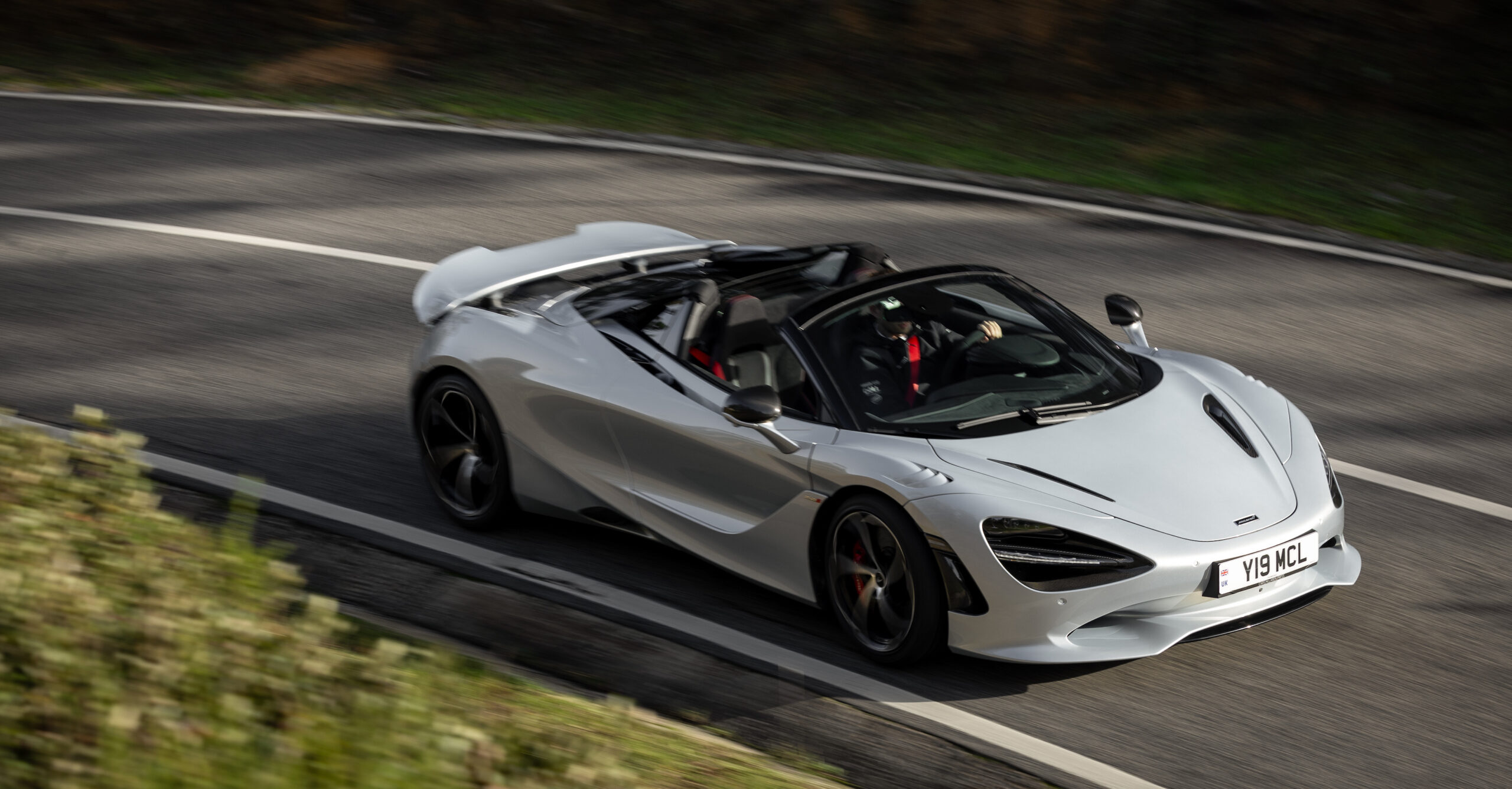
The car I picked up, a 750S Spider to be precise, is more than a mere evolution from its predecessor, the 720S Spider; it represents a great step forward in the lineage of performance extractable from this already incredible base. McLarens are renowned for their precise and razor-sharp steering; the 750S delivers every nuance of the road surface with telepathic clarity. This level of engagement stems from the chassis McLaren calls Carbon Fibre Monocage II-S, which, despite its long name and being a convertible, provides incredible structural rigidity, ensuring the mid-engine beast remains composed under the highest of loads.


The 750S, while sharing the very same chassis and many components from the 720S, benefits from a track widened by 6 millimeters and a revised spring and damper design, as well as a bolstered hydraulic steering system, making the car incredibly agile. Behind the cockpit sits the same 4.0-litre twin-turbocharged V8 found in the 720S, however tuned up by 30 hp and now producing a formidable 740 hp and 800 Nm of torque. This powertrain allows the lightened 1,438 kg roadster to punch from zero to 100 km/h in a scant 2.8 seconds, eventually reaching 200 km/h in only 7.3 seconds.
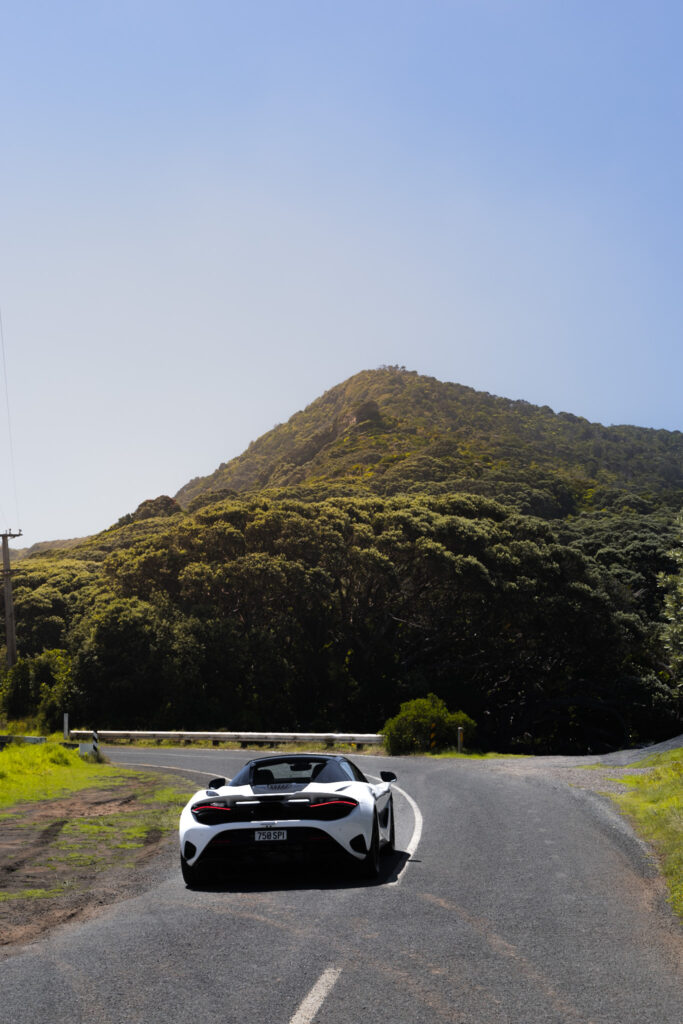
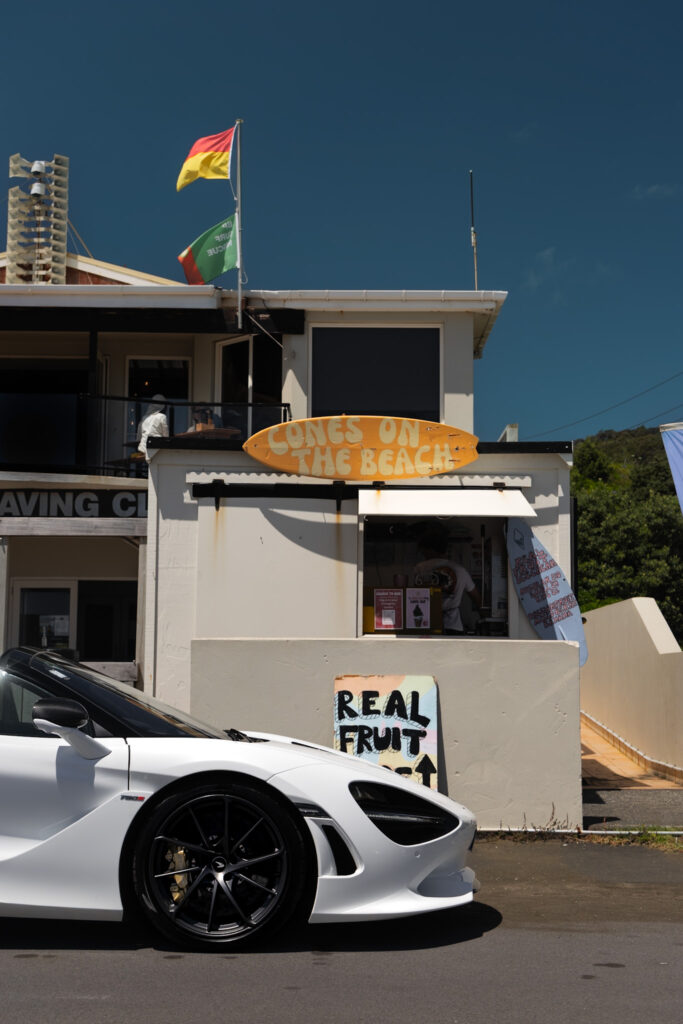
My journey began at the dealership, McLaren Auckland, which kindly provided a stunning specimen finished in a shining Silica White with a stark and clean driver-focused black interior. Navigating the twisty ribbons of tarmac through Waitakere Ranges Regional Park, the car feels like a natural extension of one’s own limbs. As we carved through the humid, sun-drenched forests, the lightweight forged alloy wheels remained glued to the asphalt. The car is always where you want it to be on the road. Underneath those wheels, lightweight Brembo carbon-ceramic stoppers, 390 mm discs at the front and 380 mm at the rear, tempered the car’s ability to surge, providing immense, fade-free deceleration entering corners. During this leg, the roof remained firmly closed; the New Zealand sun was proving intense, and the air was thick with a sweaty humidity better managed by the car’s climate control.
While some turbo-lag exists, the “ketchup effect” found in earlier models has been smoothed out. The delivery is now more linear, yet no less ferocious. After driving through the incredible greenery of New Zealand’s forests, I soon reached the coastal town of Piha. Here I was reminded of the car’s proximity to Muriwai, the beach where Bruce McLaren secured his first competitive victory. History felt close. After a short, slow cruise along the beach and a few thumbs up from happy midday surfers carrying boards to their big 4×4 trucks, the car felt equally misplaced and at home.
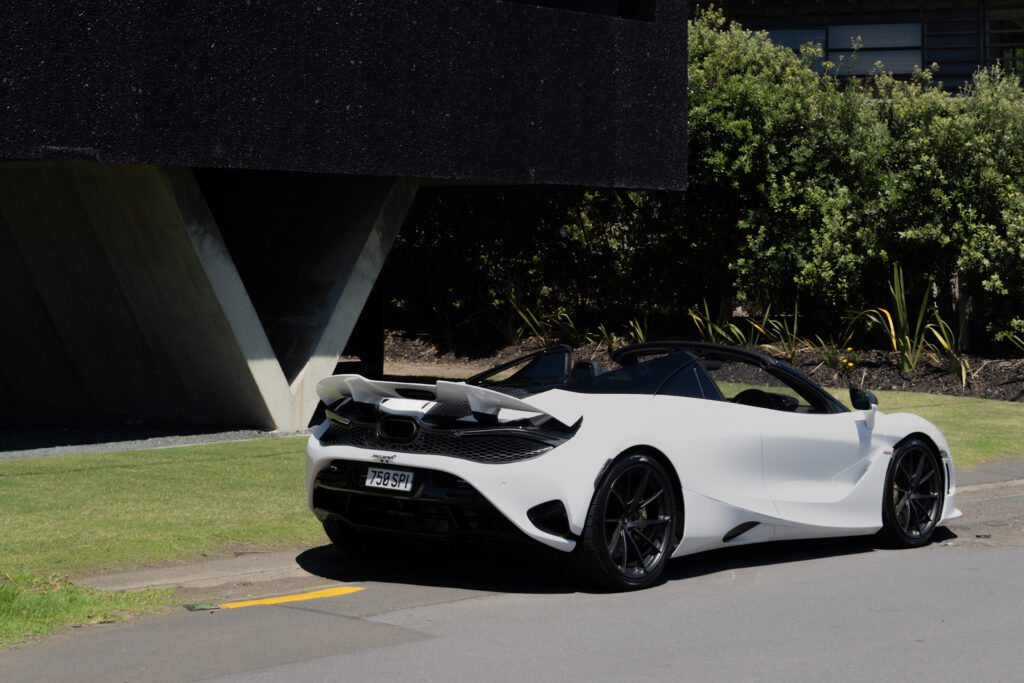
As late afternoon approached, and after a cooling ice cream break at the local beach hub, the sun retreated behind a layer of clouds, bringing a welcome drop in temperature. As I slowly rolled back out of Piha into the twisting mountain roads above, this provided the perfect opportunity to retract the roof and let the world in. The folding mechanism takes a mere 11 seconds and operates at speeds up to 50 km/h, so no need of stopping. With the roof retracted, the V8’s howl became an unfiltered soundtrack, punctuated by a sharp roar on every throttle increase and crackles and pops on every downshift. The car came alive. Gas pedal goes down: engine revs and roars, steering wheel turns: front moves where the wheels are pointing, brakes are floored: the pads squeeze the discs and the air brake in the back pops up making the car stop at an instant. This is how a driver-focused car should behave.
In the thinning traffic, the true focus of the 750S became clear. It is a car built for the driver, a machine demanding attention and rewarding it with unparalleled dynamics. Even the relaxed highway cruise between the mountain roads and back to the McLaren Auckland dealer felt engaging, yet never stressful. This car certainly could be used every day.
Driving a McLaren is always an occasion; driving a Spider is also an occasion, and driving this McLaren Spider in the antipodes of Europe, on the very roads of New Zealand shaping the racing legend behind this iconic brand, is a pilgrimage every driving enthusiast should undertake.