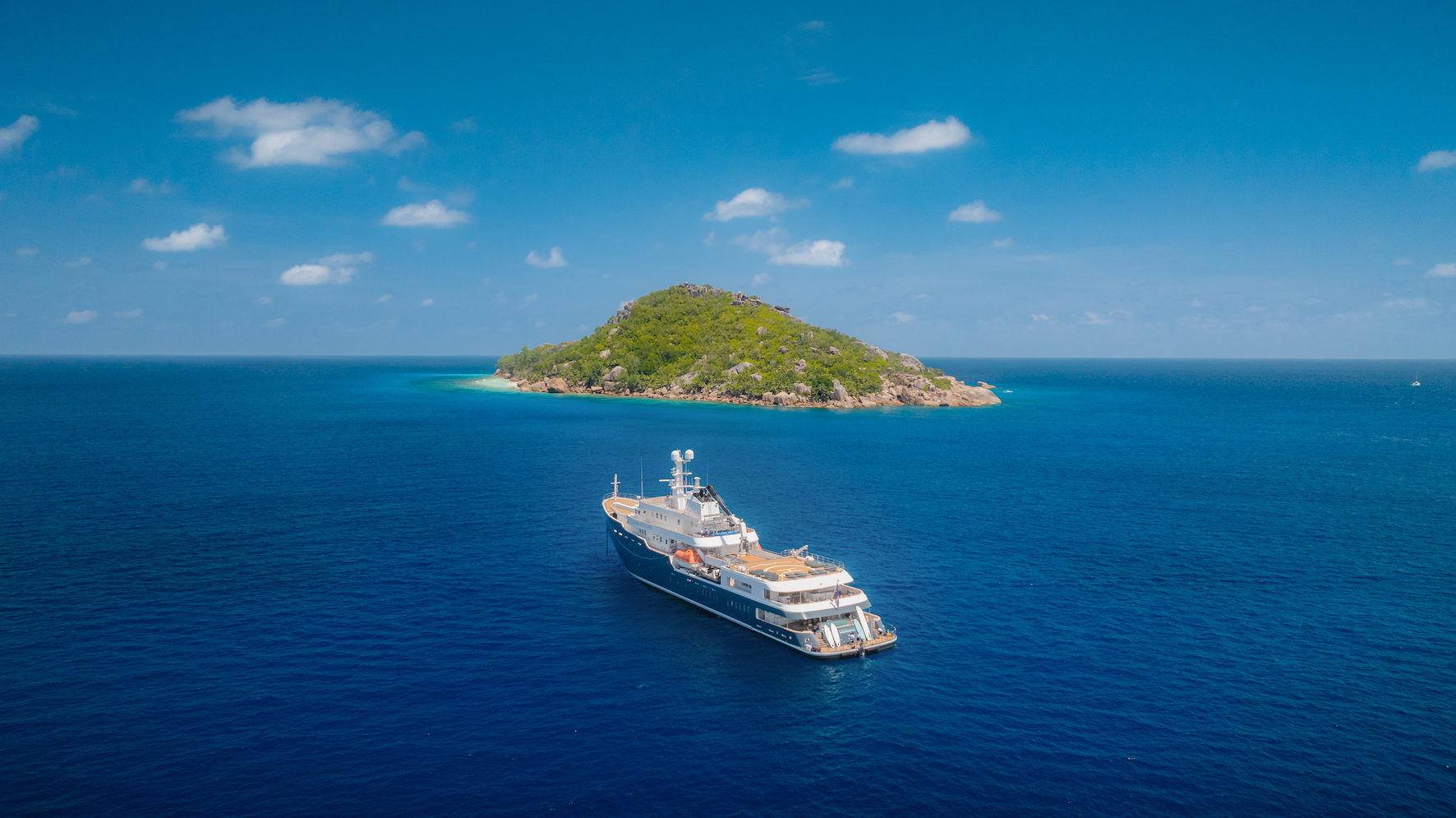
From the outer islands of the Seychelles to the coastline of Tanzania, Aqua Lares reveals a part of the Indian Ocean few travellers—and fewer yachts—ever experience.
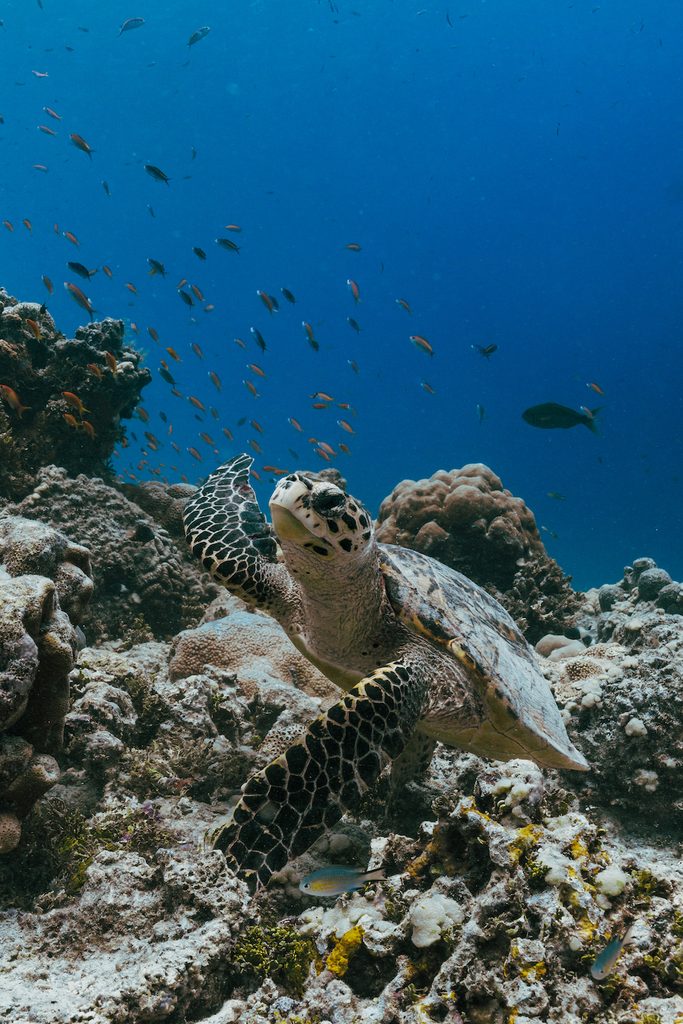
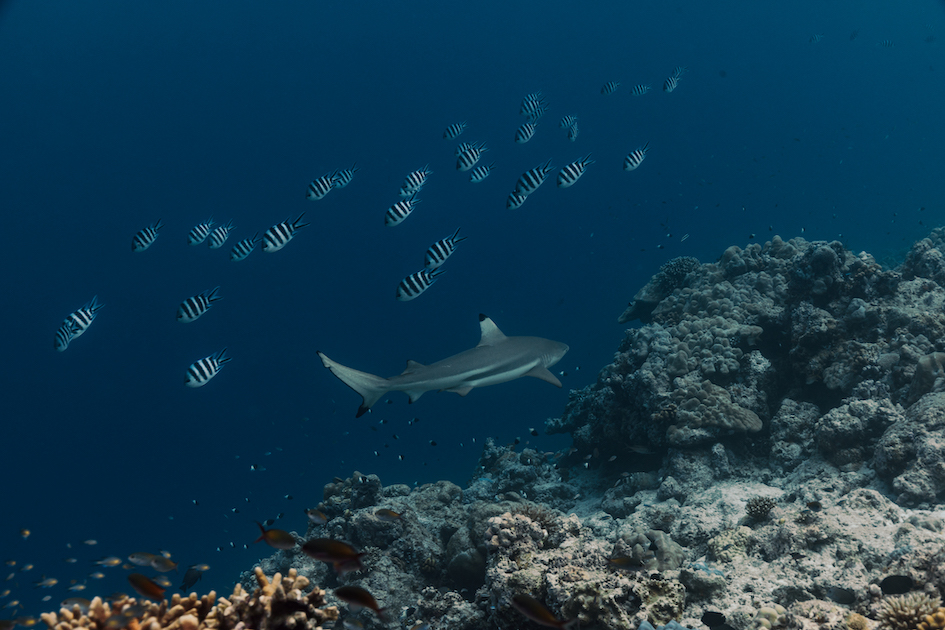
The tenders glide through a narrow gap in the rock into a wide lagoon so shallow that the water barely reaches the propellers. We all gasp as, beneath the boats, dozens—then hundreds —of juvenile blacktip reef sharks flick between the shadows, while tiny turtles speed through water so clear they appear suspended in air, almost seeming to be racing. There isn’t another boat in sight, nor a jetty, beach club or sign that anyone comes here with any regularity—if ever.
We drift deeper into the remote Seychelles spot and notice a familiar sight: the bright red umbrella from our beach party a few days earlier, with our favourite bartender beaming beneath it. While we’ve been gawking at marine life, the crew have been unloading something unexpected—not snorkelling equipment, but a bar.


Within minutes, chilled rosé and cocktails are arranged on a table standing in ankledeep water. Guests paddle over with drinks in hand, watching frigatebirds circle overhead while the sharks continue weaving between their legs.
Then, just as quickly, it’s over. The tide begins to fall. Glasses are collected. The bar disappears into the tenders. Within minutes, there is nothing to suggest anyone has ever been here. That single experience captures the essence of Aqua Lares. Rather than permanently imposing luxury on the destination, the superyacht quietly slips into places that remain largely untouched before leaving them exactly as they were found.
It would be easy to think we’d stumbled across this hidden corner of the Seychelles by chance. In reality, this moment had taken months to create. The lagoon was discovered during reconnaissance with local guides as Aqua Expeditions developed one of its newest itineraries, exploring the remote outer islands of the Seychelles before continuing west to Tanzania and Zanzibar.
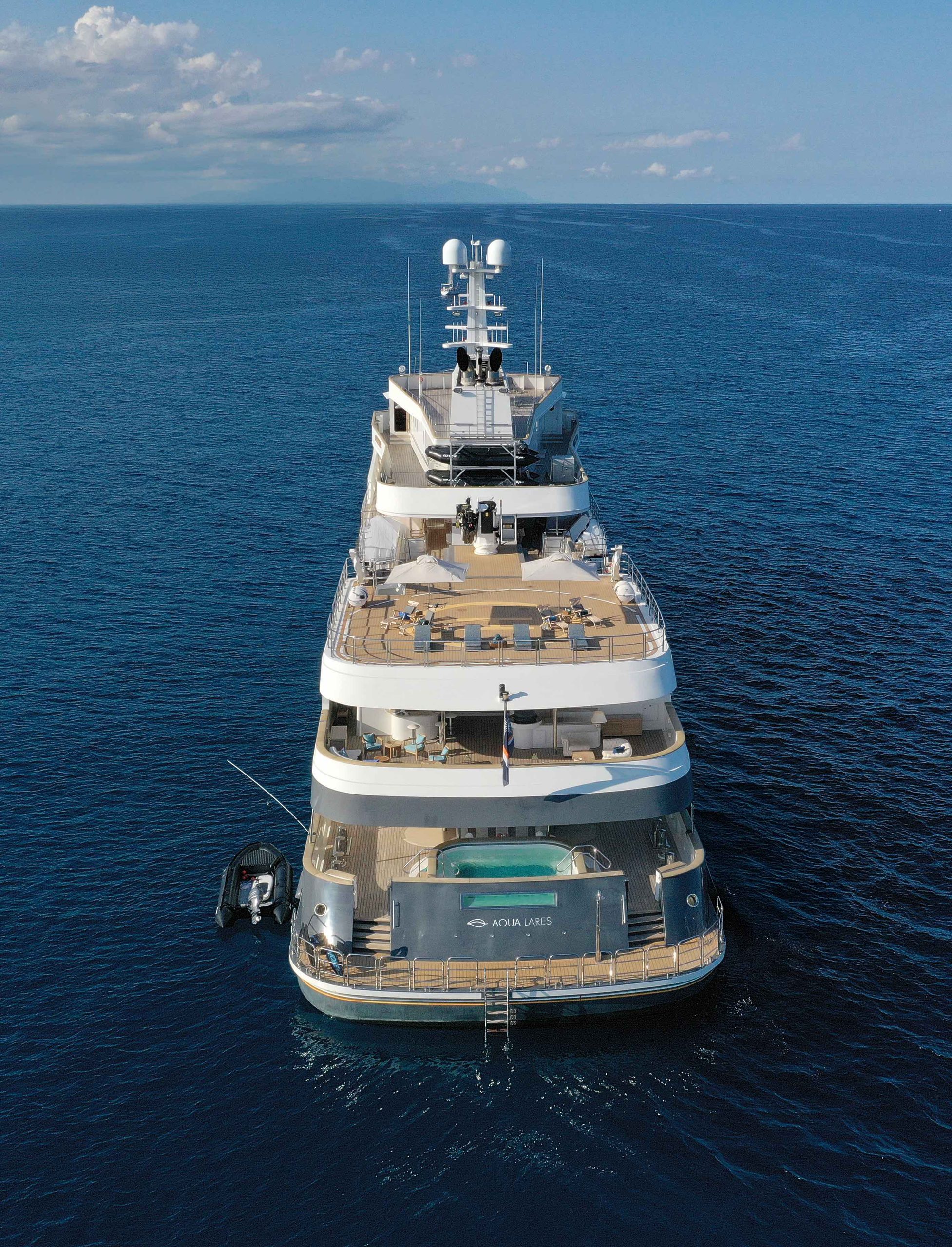
Aqua Lares, which was acquired by Aqua Expeditions in 2025, began life in 1974 as the expedition vessel Legend, earning a reputation exploring polar waters. Following an extensive refit, the vessel now carries just 30 guests between two very different worlds, spending part of the year exploring the tropical waters of the western Indian Ocean before returning north for Arctic expeditions around Svalbard and Norway.
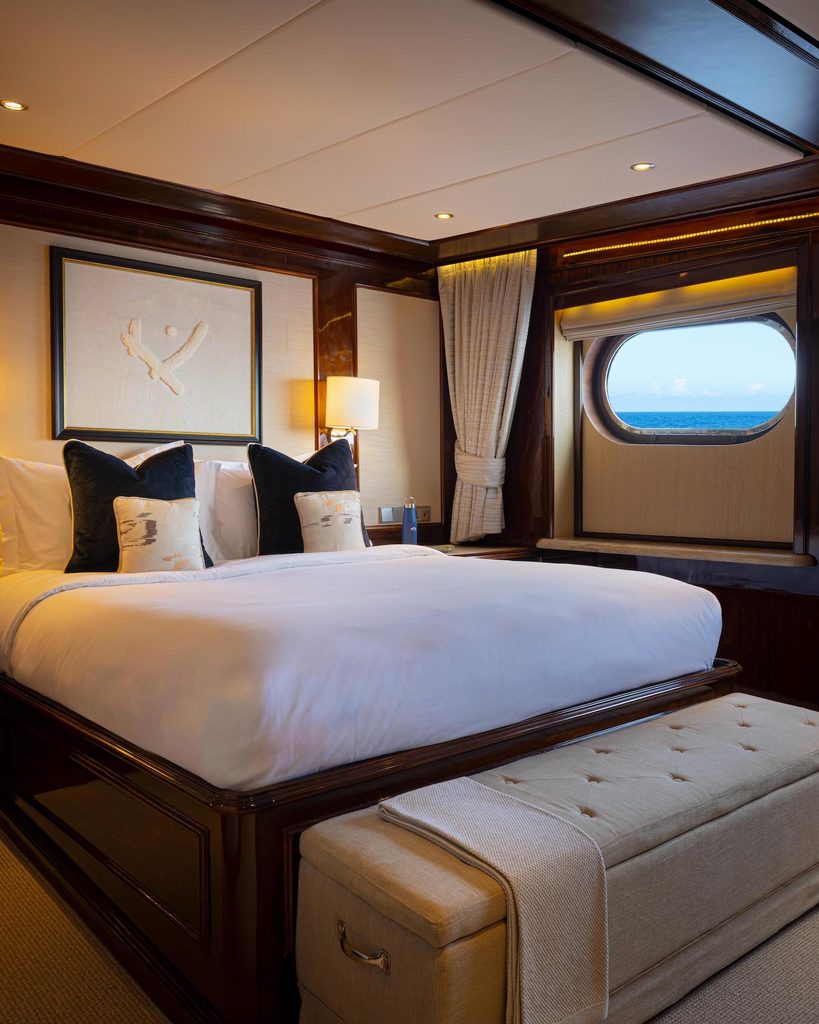
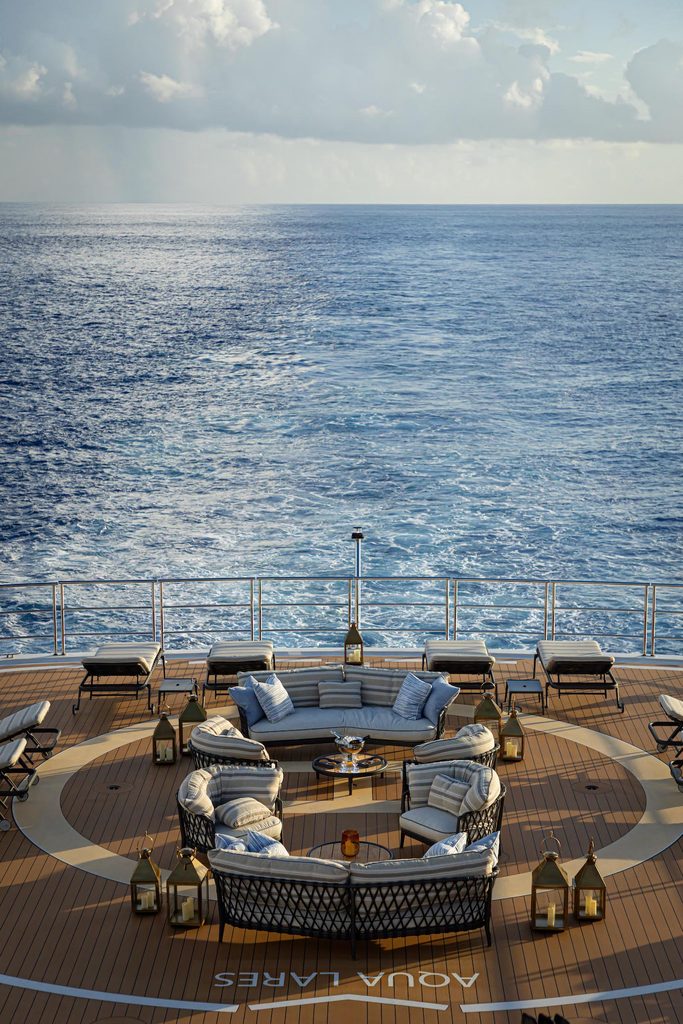
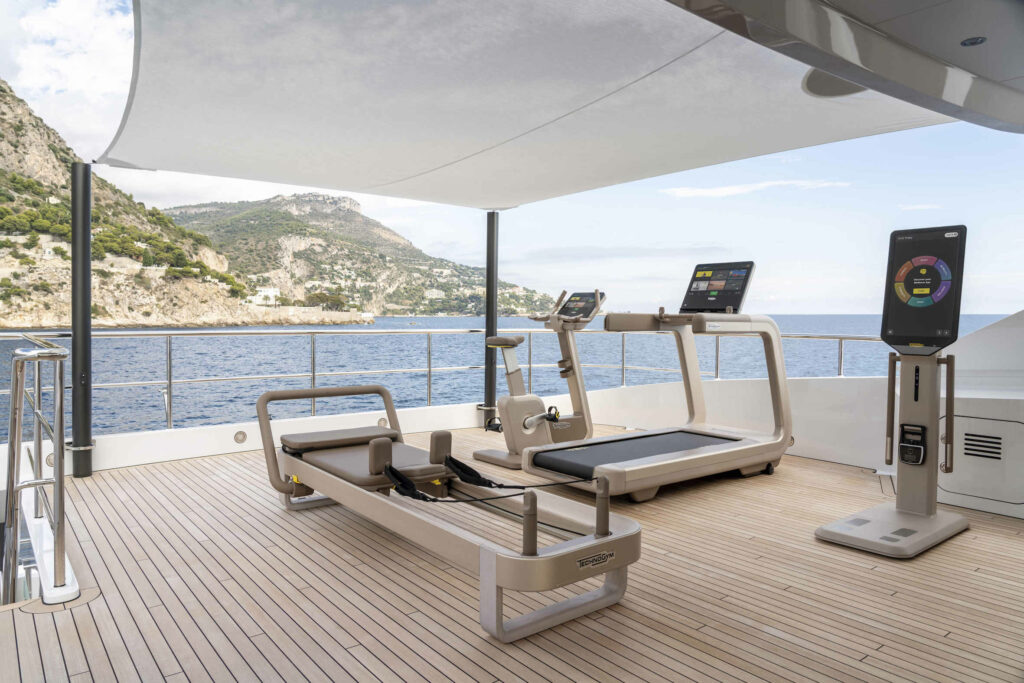
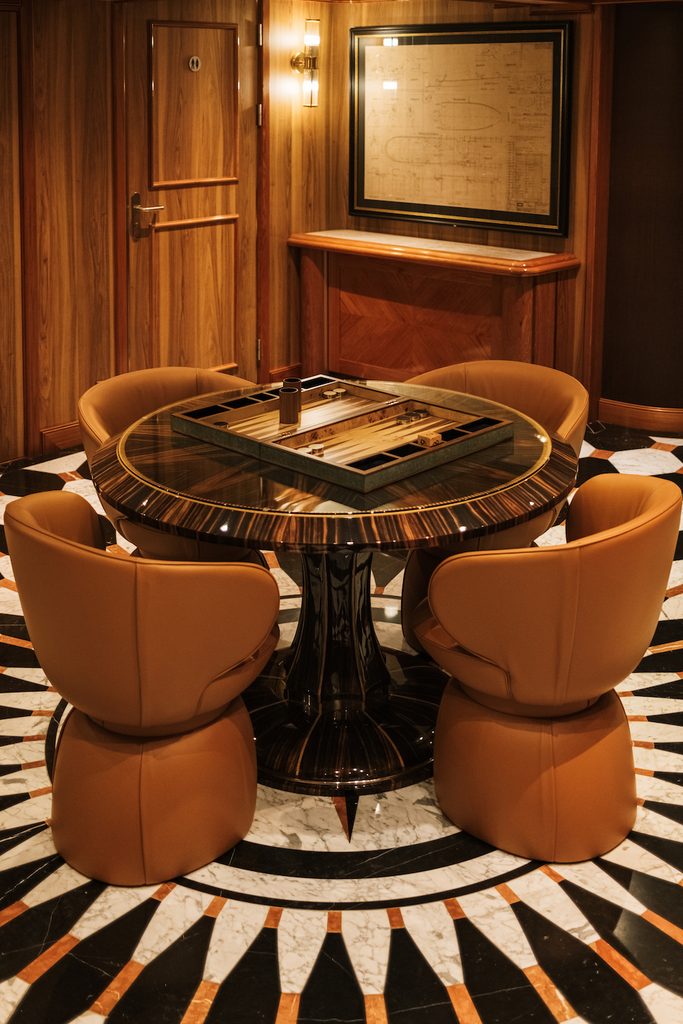
Her pedigree is now paired with spacious suites, refined dining and generous decks designed for warmer waters. The former helipad has become a setting for sunbathing during the day and aperitifs at sunset, while the scale allows guests to return from remote landings to the comfort and personal service of a private yacht—although, unusually for this sector, Aqua Expeditions’ yachts can be booked by the cabin.
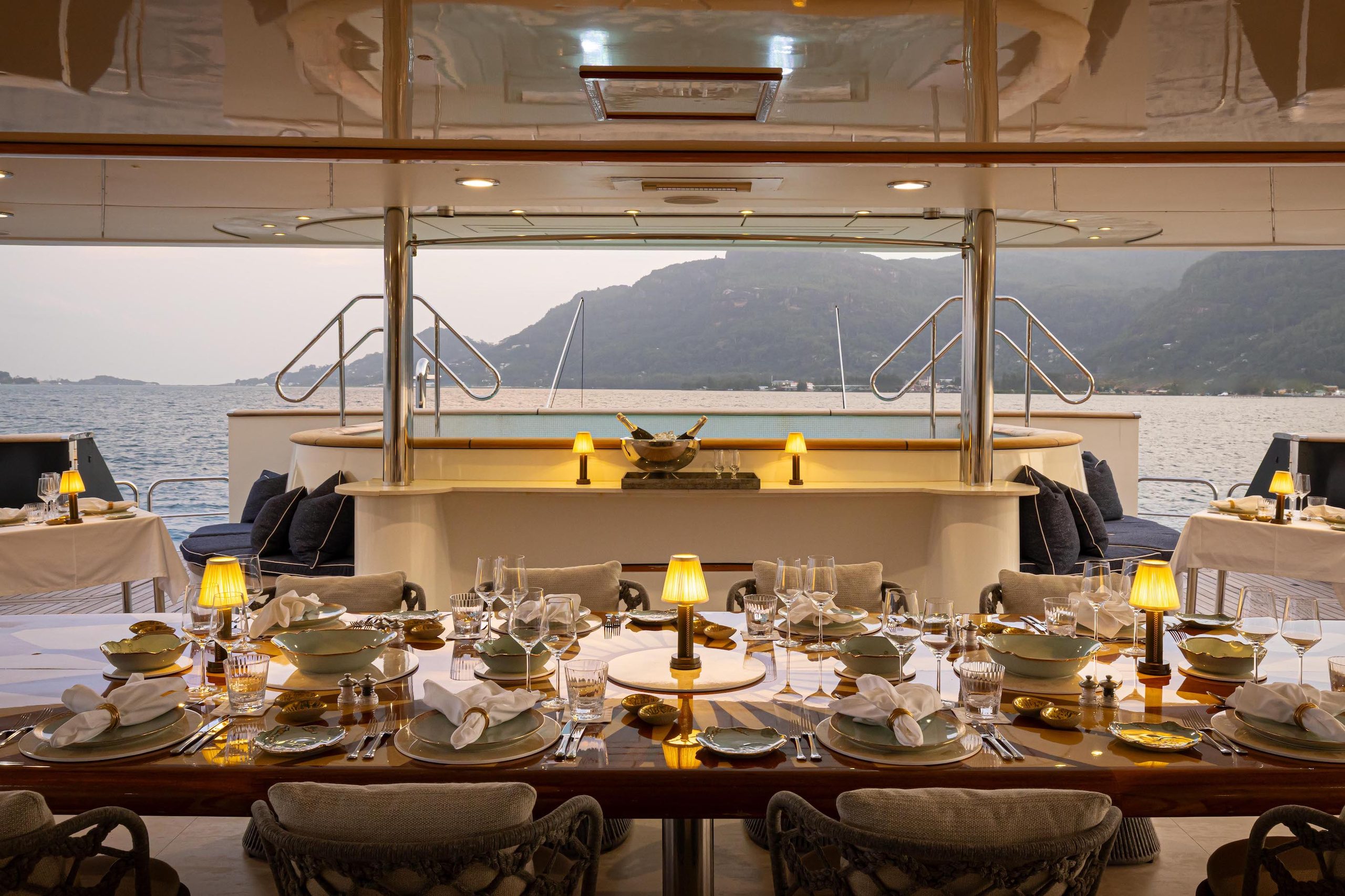
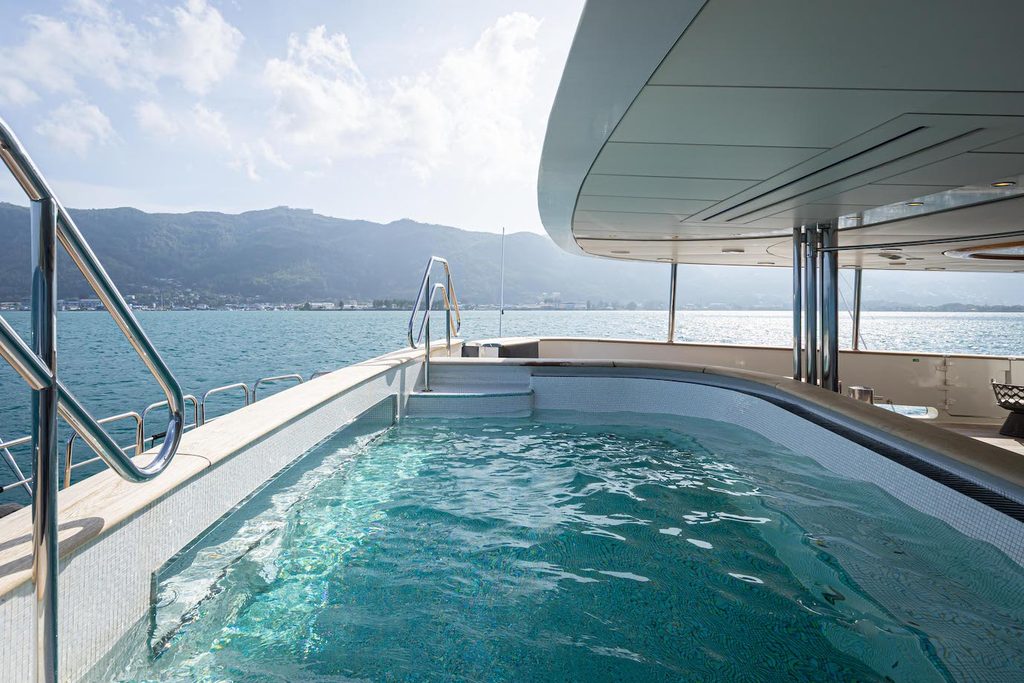
Each day brings a different expedition, from remote island landings to scuba diving and wildlife encounters alongside the expedition team. Between excursions, the yacht becomes a place to slow down; guests scatter between the spa, heated plunge pool and open decks, with plenty of space to seek solitude when needed. Evenings, meanwhile, draw everyone back together over menus developed by Aqua’s consulting chefs and adapted to the region.
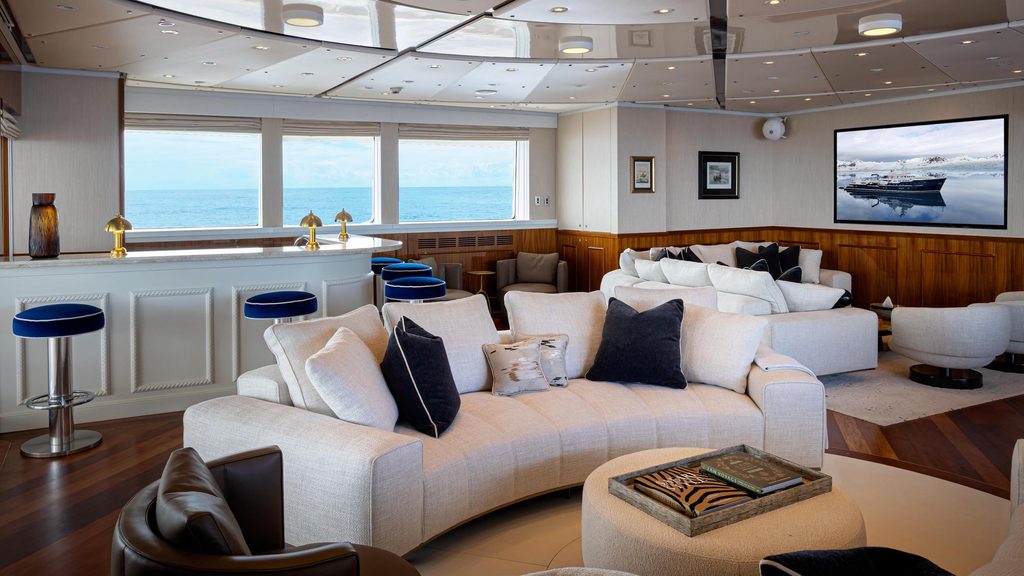
Aqua Lares also offers one of the relatively few ways to experience the atmosphere and service of a private superyacht while booking by the cabin. Most guests on our sailing are couples, travelling from the UK and the US. The nightly cocktail hour soon evolves into a fixture, bringing everyone together before dinner and helping the group form the easy camaraderie that would carry through the voyage.
With so few guests, service feels personal: preferences are remembered, conversations continue from the tenders to the dining table and the international crew respond to the mood of the group, whether that means setting up water toys off a sheltered beach or creating an impromptu celebration on deck.

Despite the yacht’s impressive capabilities, the voyage is ultimately about the destinations and the people who ensure they’re accessible. Throughout the voyage, local knowledge makes almost every experience possible. Conservationists, marine biologists, fishermen, naturalists and guides each unlock another layer of this little-known corner of the Indian Ocean. Those encounters draw on passed-down knowledge shared between local communities and expedition teams.
Although there is an itinerary, even that remains flexible, adapting to weather, tides and opportunities as they arise. Much of that freedom rests with a crew whose role extends well beyond hospitality, combining the instincts of excursion leaders with the personal service expected aboard a luxury yacht. This is expedition travel at its best: carefully planned, yet never entirely predictable.
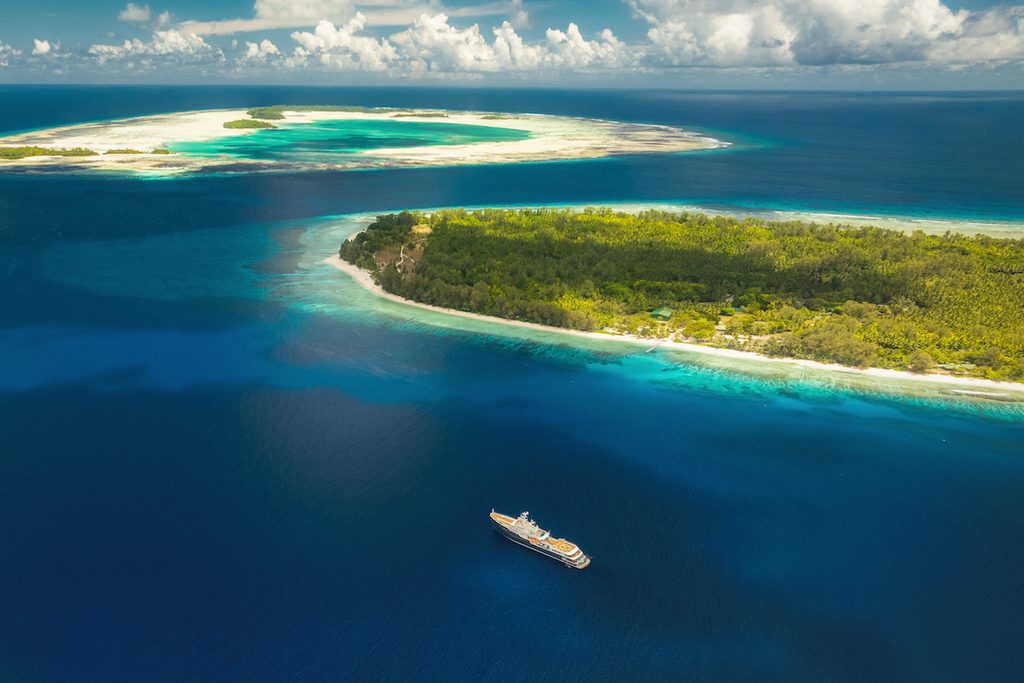
Much of the world’s attention falls on Mahé, Praslin and La Digue, whose granite boulders and palm-fringed beaches have become synonymous with the Seychelles. Aqua Lares spends much of its time elsewhere. Days from the familiar tourist trail, the outer islands feel like another country altogether. Some are inhabited only by researchers. Others welcome only a handful of visitors each year under tightly controlled permits. The distances alone deter most travellers, while the logistical challenge of reaching them means even private yachts rarely venture this far.
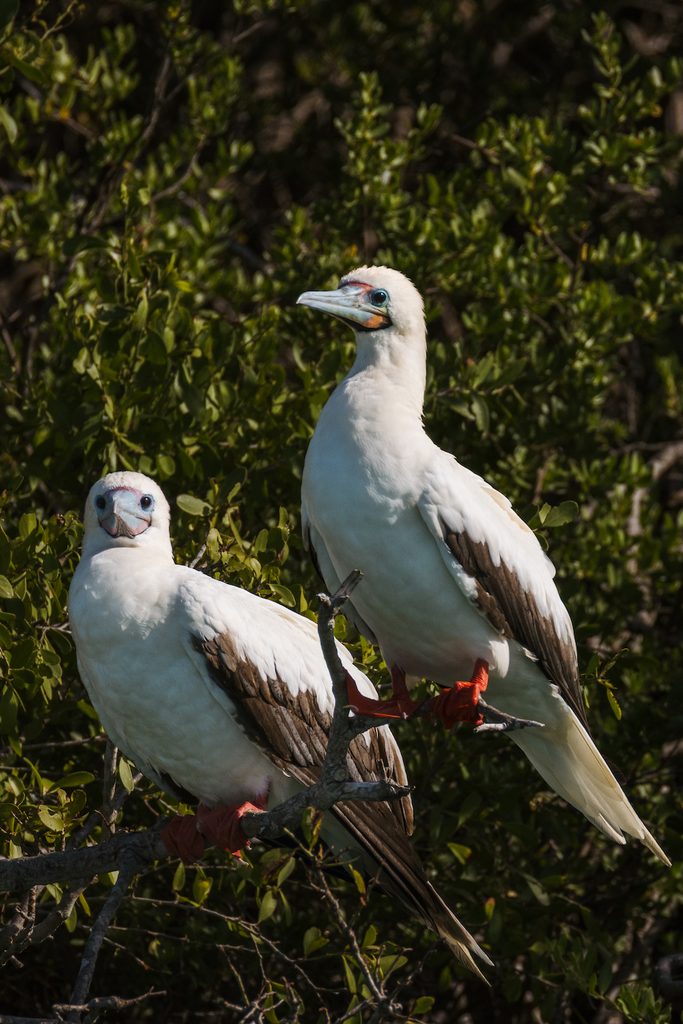
The people protecting these islands are just as much a part of the story. Landing on Aldabra Atoll—one of the world’s largest raised coral atolls and a UNESCO World Heritage Site—is unlike arriving anywhere else. Before we are even allowed ashore, researchers painstakingly inspect every bag. Grains of sand are picked from the soles of our flip-flops with tweezers and our pockets are turned inside out. The process initially feels excessive, but later that day, while walking among giant tortoises that have wandered these islands for aeons, the reasoning is impossible to question. Their tracks criss-cross the sand before disappearing into dense vegetation, while frigatebirds wheel overhead and coconut crabs move through the undergrowth.
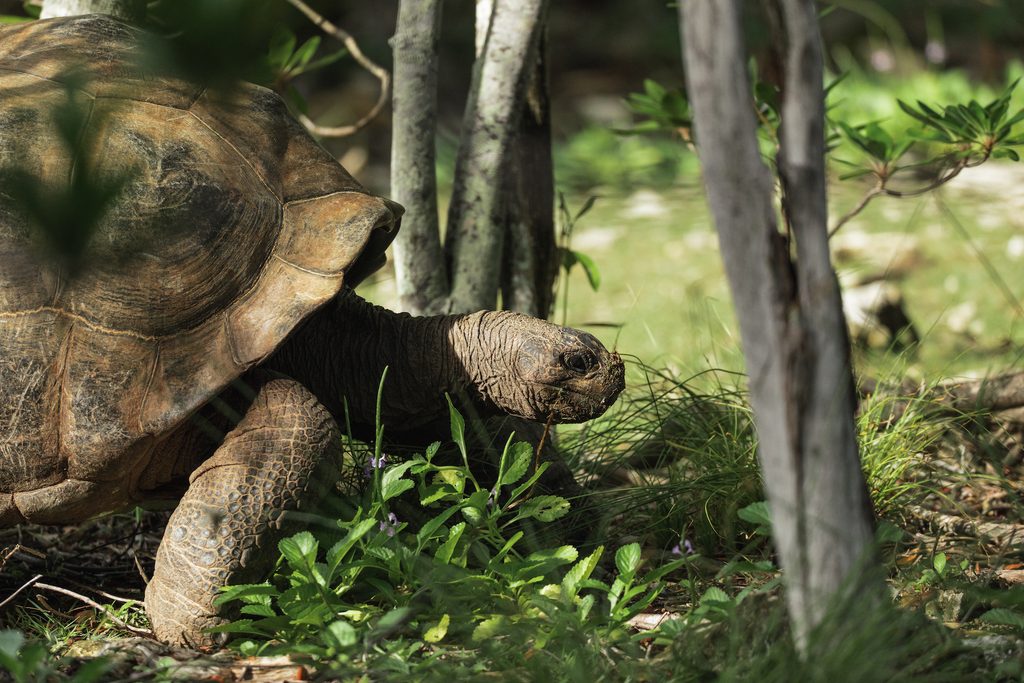
Much of Aldabra’s protection depends on the scientists who spend months at a time living at the research station, monitoring wildlife in one of the most isolated places on Earth. Life is governed by the tides, the weather and the movements of the animals. Meeting the researchers gives the visit greater weight, revealing the work required to preserve an ecosystem that has changed remarkably little over centuries. As such, there are no hotels, restaurants or casual visitors here. Fewer than 1,000 travellers are granted permission to visit in a typical year, making Aqua Expeditions’ access to the atoll especially significant.
For those keen to venture deeper, Aqua Lares is fully equipped for diving, with the expedition team leading up to two dives a day across reefs, walls and coral gardens that are seldom observed. One morning might mean drifting alongside Astove Island’s sheer coral drop-off as reef sharks patrol the blue, while the next could bring a slower dive through coral gardens alive with turtles, rays and vast schools of tropical fish. Like every aspect of the itinerary, the sites are chosen according to conditions, allowing the team to make the most of the weather, tides and visibility while revealing the diversity of the outer islands beneath the surface.
Our 11-day voyage from Mahé to Zanzibar is not just about solitude. Crossing into Tanzania introduces another side of the Indian Ocean, where communities have lived alongside the sea for generations. Few luxury yachts venture this far south; with limited superyacht infrastructure, the coastline is explored more often by local fishermen than visiting vessels. That is what attracted Aqua Expeditions: Aqua Lares is helping to open up a new cruising route through East Africa.
One morning, we visit Pemba Island, discovering clove plantations, forested hills and the remains of former sultanates that speak to the island’s long trading history. On another, we explore Kilwa Kisiwani, where the ruins of mosques and palaces reveal the wealth of a Swahili trading port that once connected East Africa with Arabia and India.
On one particularly memorable excursion, we leave Aqua Lares behind and climb aboard weathered wooden sailing boats operated by local fishermen whose families have navigated these waters for decades, or even centuries. Our destination is a bay off Mafia Island where whale sharks are present year-round. Guided by epochs of local knowledge, we have every chance of finding them. Within an hour, we spot a female around 9 m long moving along the bottom of the lagoon. Our guides tell us to pull on our masks and fins, and seconds later we are in the water slightly ahead of her, watching as she passes through the clear water below, seemingly untroubled by our presence. Once again, the group falls silent.
Back aboard the dhow, conversation turns to disbelief. For many of us, it’s the first time we have swam alongside the world’s largest fish; for the fishermen, though, it’s simply part of life on these waters. Among our group is a guest who admits she has never snorkelled before this trip and is nervous even at the thought of sharks. Earlier, she was the first to leap from the side of the boat, eager not to miss the enormous silhouette passing beneath us. Watching her apprehension give way to excitement captures something the journey does so well: gently encouraging people beyond their comfort zones.
Returning to Aqua Lares, those moments continue long after each excursion ends, thanks to the attentiveness of the crew. One afternoon, they transform a tiny island—small enough to walk around in just a few minutes—into a pop-up beach club, complete with fresh cocktails, loungers and music. On another day, a sandbank briefly emerges from the Indian Ocean before disappearing beneath the rising tide a few hours later. Music drifts across the water as drinks are poured and guests dance barefoot, reluctant to return to the tenders even as the tide begins to reclaim the sand beneath us.
There is nothing performative about these experiences. They are thoughtful responses to the places around us, created by a crew who take genuine pleasure in making each day feel different from the last. Luxury aboard Aqua Lares is measured by the privilege of access: to remote islands, extraordinary wildlife and the people who understand them best.
From €18,545 per person for 11 nights on the Coralline Seychelles & Zanzibar (Tanzania) itinerary; rates for a full 11-night charter start from €733,000; more info at aquaexpeditions.com