With more than 90 untouched islands, extraordinary coral ecosystems and a plethora of ultra-luxury resorts and life-affirming experiences, the Red Sea, Saudi Arabia, is becoming the world’s most attractive playground for adventurous travellers.
The wind whips through my hair as the gleaming new fibreglass speedboat accelerates out of the calm bay and into open waters, striped in shades of turquoise, in defiance of the name. Surveying the horizon, there’s not a single other boat in sight. The Red Sea is our proverbial oyster. The sun rose just a few hours earlier, and now offers a kiss of heat before my Galexea dive instructor and I zip up our wetsuits and plunge into the cool azure depths.
Saudi Arabia’s Red Sea destination is emerging as the newest frontier in luxury tourism. Previously undeveloped and difficult to access —Saudi Arabia only launched its first-ever tourist visa in 2019—this region, 500 kilometres north of the country’s second-largest city Jeddah, remains off the radar for many international travellers—giving adventurers who venture here the thrill of discovery like nowhere else does in the world.
Spanning 28,000 square kilometres (an area only slightly smaller than Belgium), the Red Sea contains more than 90 natural islands and pairs pristine coral reefs with a new generation of ultra-luxe design-forward hotels, the first such properties in any of the nine countries that surround this body of water. There’s also a game-changing adventure district, ADRENA, as well as Saudi’s first 18-hole championship golf course found on an island.
Sighting Shebara
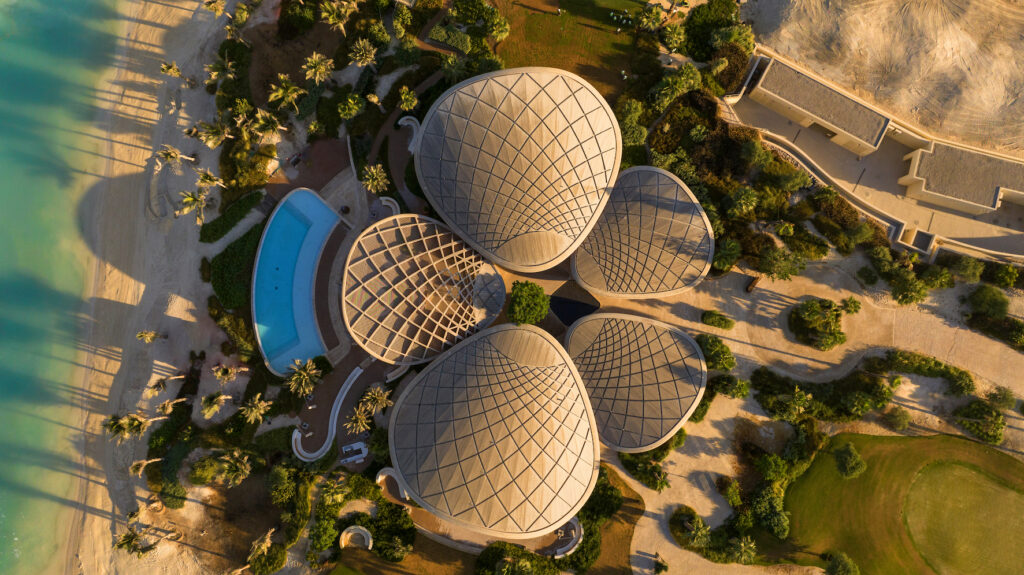
The speedboat and its four passengers—the captain, the skipper, my aforementioned scuba instructor and I—are cruising along the water when a mirage seems to appear in the distance, strung out like giant pearls floating on top of the sea. The captain slows our speed as we approach Shebara, a resort set on a remote island with out-of-this-world rooms shaped like mirrored bubbles.
Laced together like an elegant necklace by boardwalks, their polished stainless steel exteriors reflect the water and the sky with cinematic precision. Inside, rooms are designed to mimic docked superyachts, while marshmallow-white sofas rest behind the pods, whose individual infinity pools gaze out to the sea from their private perches. It’s a profound vision of the future, and one deeply connected to its locale.
The speedboat carries on for a few minutes to Al Haria, today’s dive site. My dive-logging app has never heard of it. Google searches I make later confirm that this location is seriously off the world’s radar. We jump into the water next to rocky pinnacles that drop more than 20 metres down to the seabed, and the current pushes us past forests of colourful hard and soft coral until we’re enveloped in a school of hundreds of neon-blue Red Sea fusilier fish.
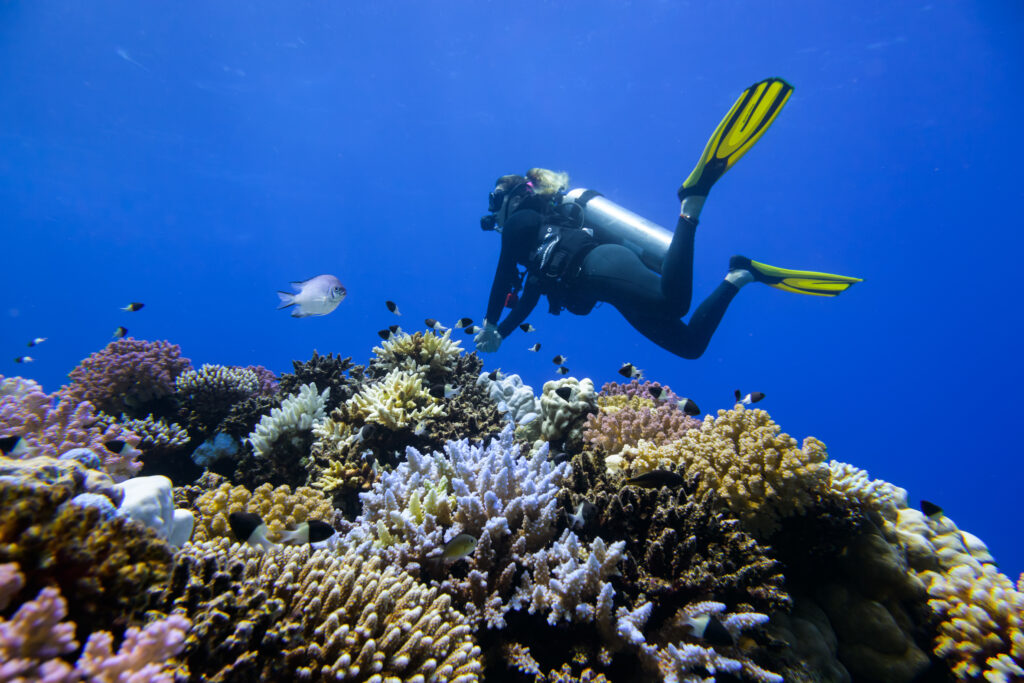
The Red Sea is one of the planet’s most extraordinary—and extraordinarily under-appreciated— marine ecosystems. Some 15 percent of its fish species are found nowhere else on Earth, and it’s home to one of the world’s longest continuous coral reef systems, which stretches for some 2,000 kilometres. The sea is connected to the Indian Ocean only through the narrow Bab el-Mandeb Strait, and this relative isolation has allowed species to evolve independently over thousands of years, contributing to the Red Sea’s high levels of endemism and ecological uniqueness.
Distinctive environmental conditions, meanwhile, abound: the Red Sea is among the warmest and most saline seas on Earth because of intense evaporation, minimal rainfall and the fact that almost no rivers flow into it. Because its corals have evolved under these challenging conditions, marine scientists believe they may be more resilient to warming oceans than reefs in other parts of the world.
It’s evident here, at a dive site where sightings include masked puffers (mostly grey save for a raccoon-like black mask around its bulging eyes) and a pair of sassy clownfish cleaning themselves in a Medusa-like anemone. Returning to the surface feels like a life-changing experience has been cut short.
Private Paradise
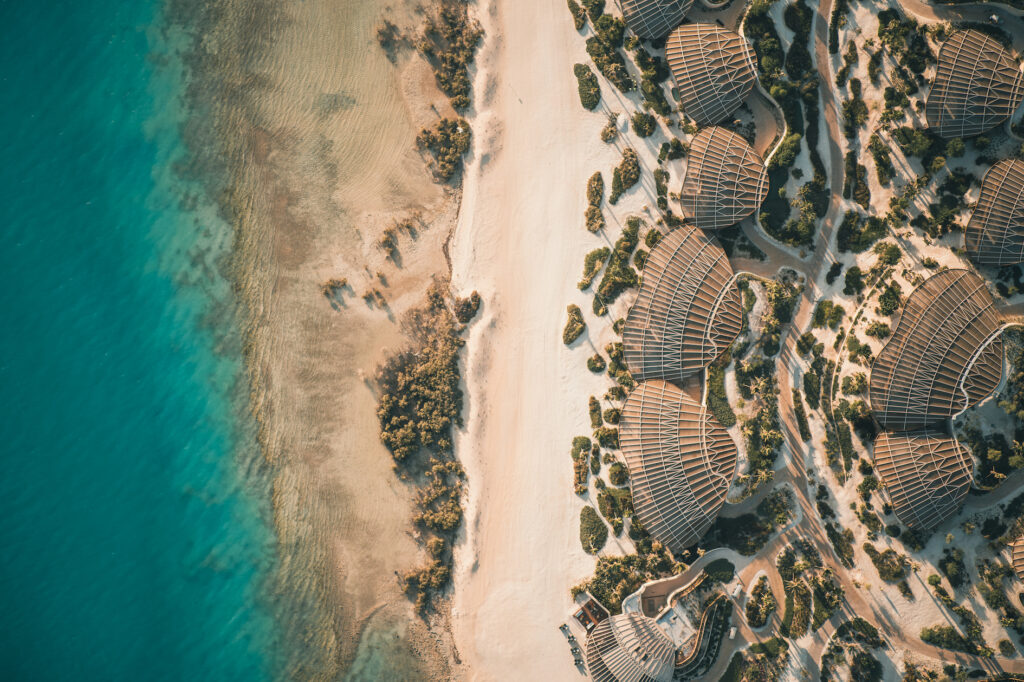
Next on the agenda is The St. Regis Red Sea Resort. Set on the Ummahat Islands, St. Regis was the first property to open at the Red Sea destination, just over two years ago. We’re miles from the mainland, so guests can arrive only by speedboat, yacht, helicopter or seaplane. Two wings of overwater villas flare out from the far sides of the island, its shape reminiscent of that of Italy, some specifically angled for prime sunset views. The calming design from Japanese architect Kengo Kuma instils a sense of peace, complemented by the villas’ light wood and white colour scheme that’s daubed with splashes of ocean blues. On the white-sand beach, the sole four-bedroom Presidential Villa comes with its own cinema room and miniature library.
The resort’s nearest neighbour, on a separate island and not visible from the bay, is Nujuma, a Ritz-Carlton Reserve, one of only nine worldwide and the first in the Middle East. Nearly a third of its villas are built over the water, shaded by wooden sculptures that resemble shells. The Reserve Masters lead experiences in yoga and wildlife sightings of blue-spotted rays, hawksbill turtle nests and the aptly named (but, sadly, critically endangered) halavi guitarfish, while resident experts at Conservation House serve as ambassadors to connect visitors to Saudi culture through local art and history. After dark, a guided astronomy session is a must—peering up at the nujuma (which means “stars” in Arabic) through a powerful telescope with little interference from light pollution is a truly edifying experience.

Back on the bay, I’m at WAMA, Red Sea Global’s watersports brand with a hub at The St. Regis Red Sea. Its curious name is a contraction of the English and Arabic words for water, while its underlying philosophy falls in line with the Red Sea’s laudable sustainability efforts. It offers overwater activities that don’t require petrol and are run entirely on wind, human or battery power, including sailing, windsurfing, glass-bottom kayaking and stand-up paddleboarding.
I decide to try my hand at riding an electric sea scooter, a device I’d never even heard of before, let alone used. It’s similar to an e-foil, a motorised surfboard that propels you on top of the water once you reach high speeds, but this model comes with handlebars for balance. I learn the ropes under the watchful eye of an instructor who turns me loose, and we’re soon riding figure-of-eights around one another (the tumble into the sea feels inevitable when it finally happens).
Shura Island: The Heart of the Red
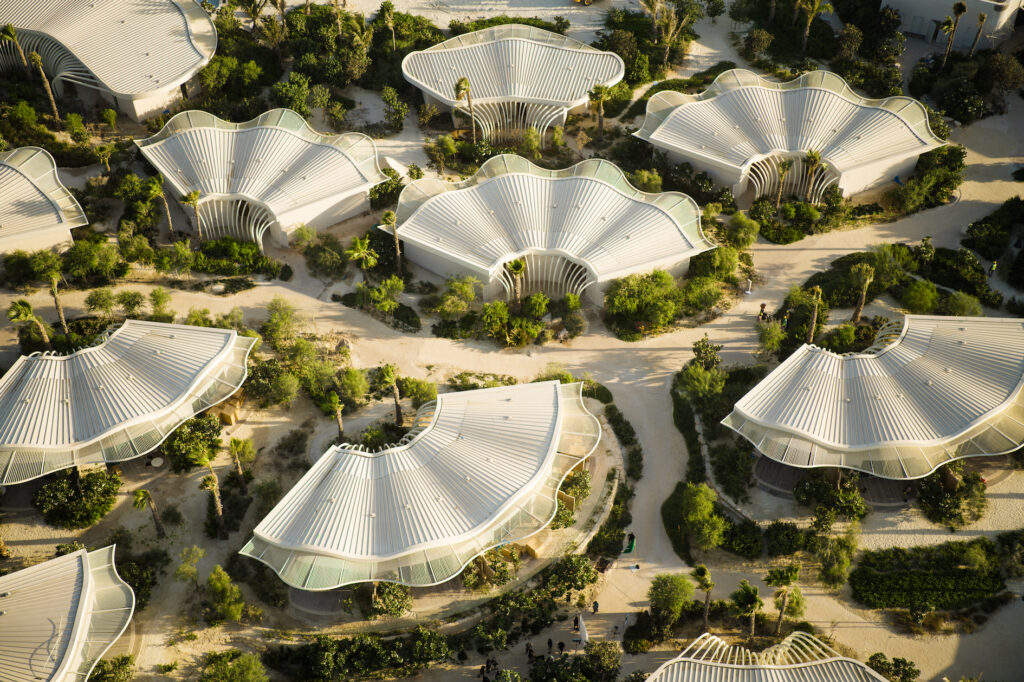
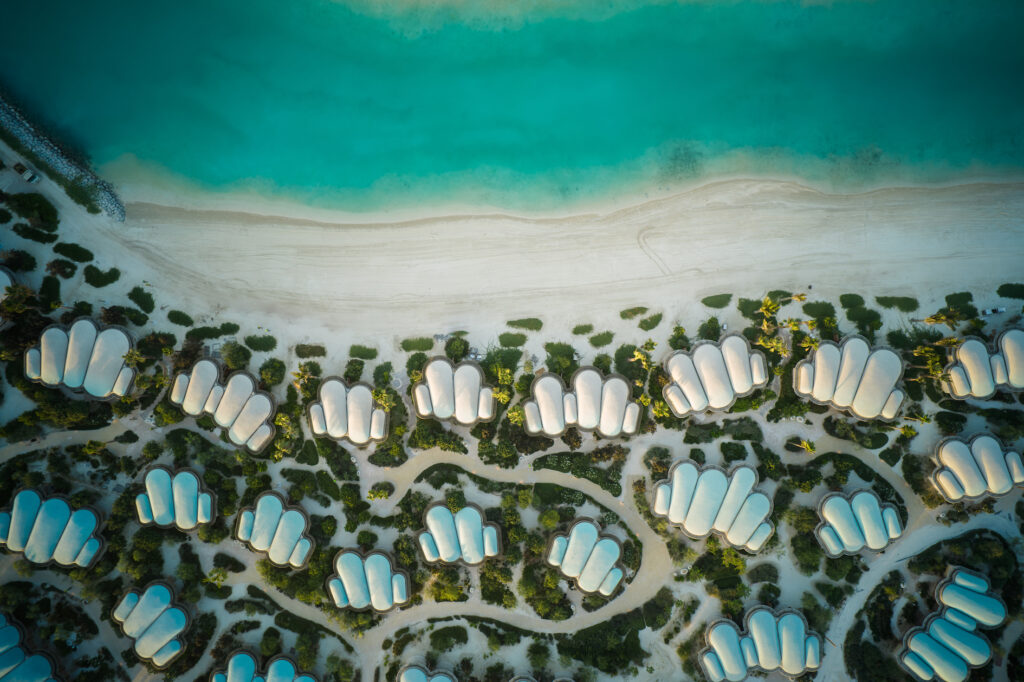
The centre of gravity, when it comes to the Red Sea’s status as a hub of world-class sustainable tourism, is set to be Shura Island: an epicentre of top-class tourism offerings, linked to the mainland by a two-kilometrelong bougainvillea-lined bridge. When complete, this island will be home not only to 11 resorts—the design of each inspired by a different type of coral found in the Red Sea—but also Shura Links, an 18-hole championship golf course, plus a yacht marina and The Village, a spectacular promenade replete with retail venues, plus dining and entertainment options.
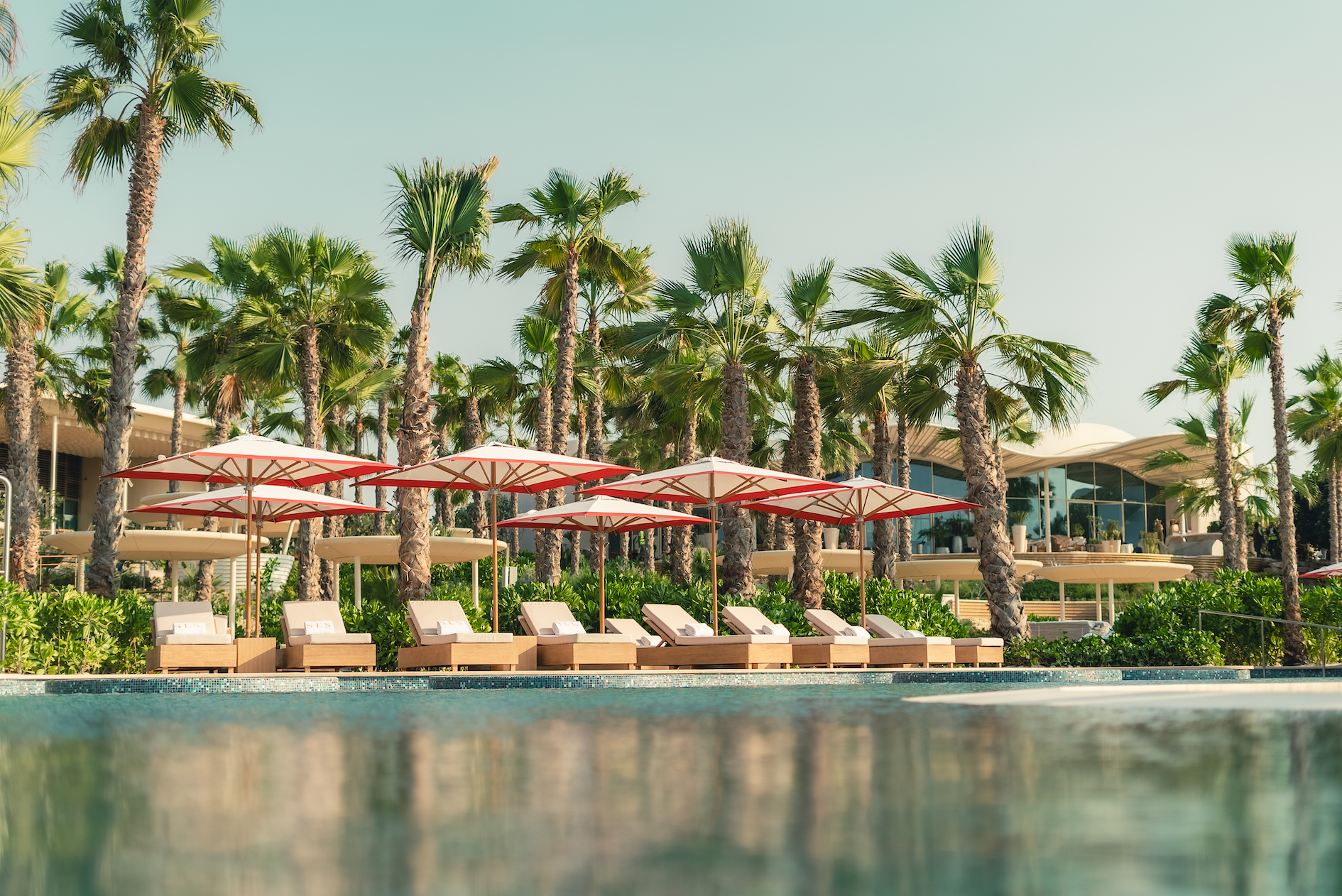
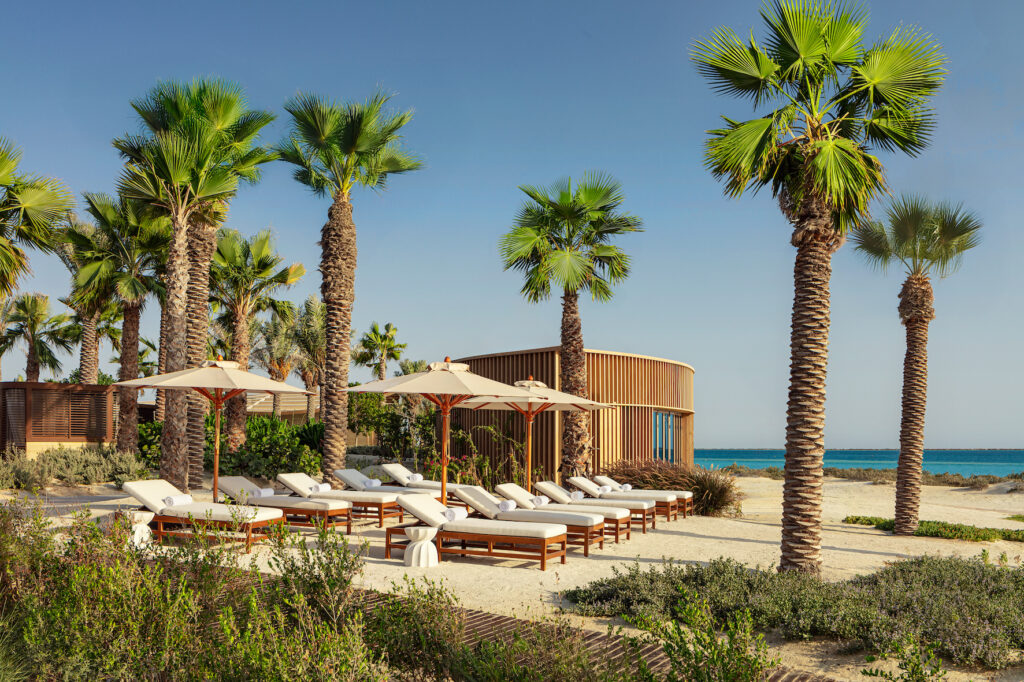
A handful of the hotels have already swung open their doors to guests, and I’m checking in at SLS The Red Sea, whose boldly mischievous personality is immediately evident in the pink lobby cafe where I’m greeted by a unicorn statue with an ice-cream cone as its horn. Outside, the signature SLS duck, an oversized rubber ducky-style sculpture sitting plumb in the pool—painted in colourful swirling patterns by Saudi contemporary artist Heba Ismail—is another sign of the playful spin on luxury to come. And not the only one. Sculpted monkeys swinging from the signs pointing to my two-bedroom beachfront suite also hint at impending quirkiness.
Inside, I’m drawn immediately to the floor-to-ceiling living room doors that frame a private plunge pool and my own stretch of white sand overlooking a sheltered inlet. As sunset draws near, I stroll aimlessly along the beach, which is littered with shells. I don’t see any footsteps from other guests, only the faint prints left by tiny fiddler crabs that scurry out of the way as I approach.
Other luxury brands, including the Raffles, Four Seasons, Fairmont and Rosewood, are set to open outposts on Shura Island later this year. My stay at SLS The Red Sea—which opened in mid-December last year—coincides with the opening night of its sleek Japanese restaurant Floating World, with its open kitchen and tables illuminated with large barrel-like paper lanterns. Plates of spicy edamame, beautifully cut sashimi and nigiri, panko-coated shrimp, and cooked-to-perfection sirloin and broccolini are all worth circling on the menu for future reference, as are the delicate strawberry and cheesecake mochi that round the sitting off.
Southeast of here, on the other side of the Shura Links—a championship golf course designed by famed architect Brian Curley—is the Red Sea EDITION: a resort which takes a high-end minimalist approach to its suite decor in cream, white and natural wood that lets the landscape of native seagrass and mangroves dotted along the beach outside do the talking.
I settle onto a cushioned seat on the furnished outdoor terrace to soak it all in. That evening’s candy-floss skies are the perfect welcome to Jiwa Beach Club, a low-lit Bali-inspired dinner spot that opens just before sunset. Many of the restaurant’s tables are dug right into the sand on the beach. It’s a dining setting where satay skewers and egg-topped nasi goreng will tingle the tastebuds with just the right level of spiciness, while three fire dancers cast a spell over diners with twirling torches and acrobatic moves.
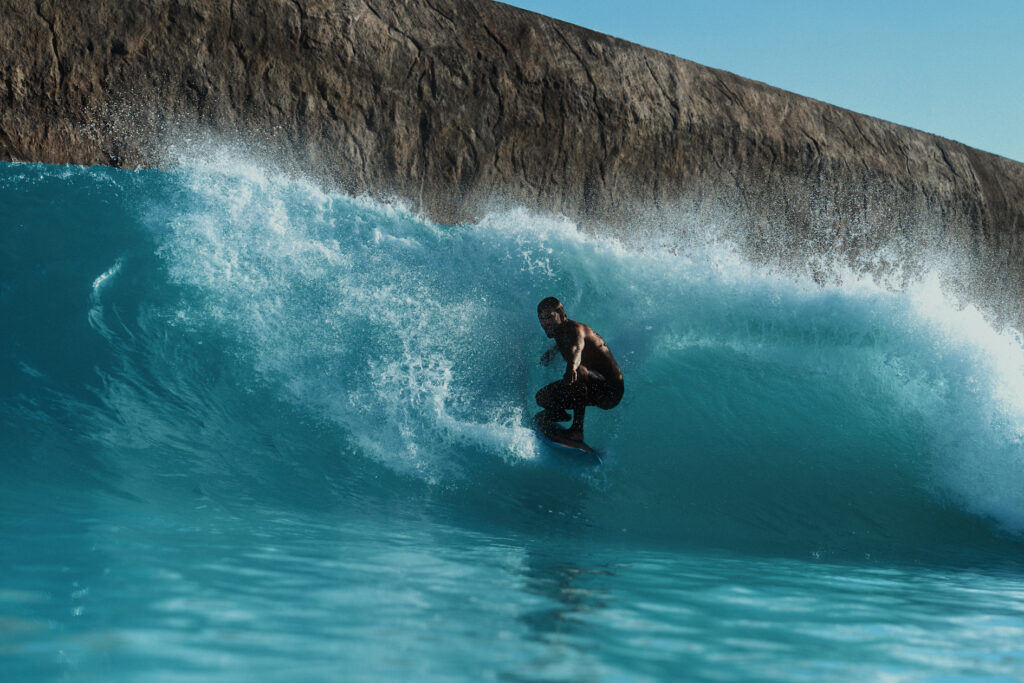
The first stop the next morning is ADRENA, an eight-kilometre drive north of Shura Island in the Red Sea’s adventure district. Part water park, part beach club, part extreme sports hub and part watersports school, the development has a three-storey tower at its centre, the view from which takes in Saudi Arabia’s largest surf pool, where the waves are finely tuned by a technician and dialled into the specific skill set of the surfer.
Nearby, a group of teenage boys try their luck on a slackline over a two-metre-deep pool before cajoling each other up to the cliff diving platforms. Elsewhere, a couple of skaters from Spain slide their boards across the ramps and rails. The sense of just how much there is to do in this part of the world—the length of the scale between lazing and becoming ultra-active—is palpable.
Sea Meets Desert Sand
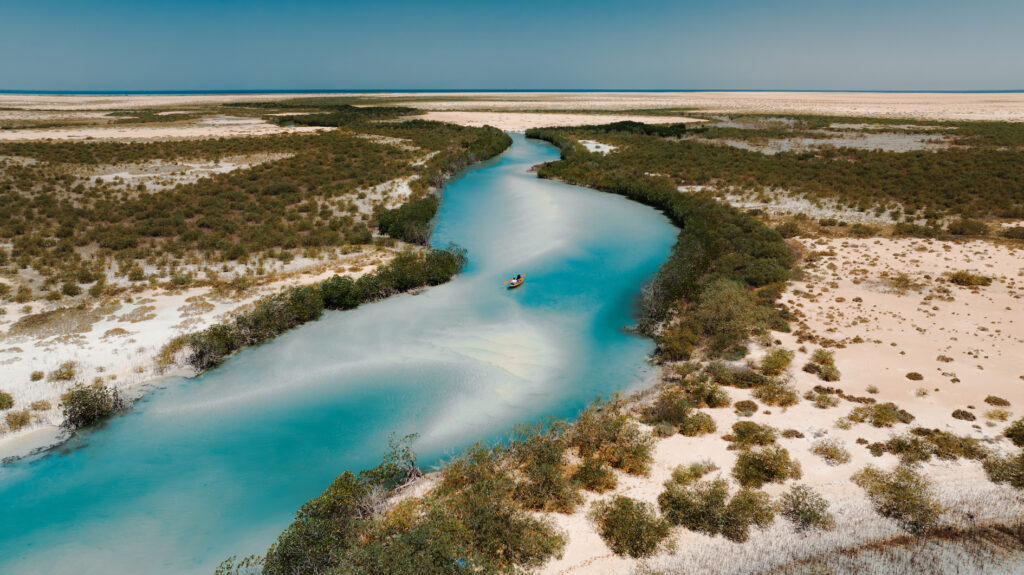
One of the most intriguing features of the Red Sea is that the experience encompasses so much more than secluded islands, untouched coral reefs and lazy days on a yacht deck. The geographical diversity is a true eye-opener.
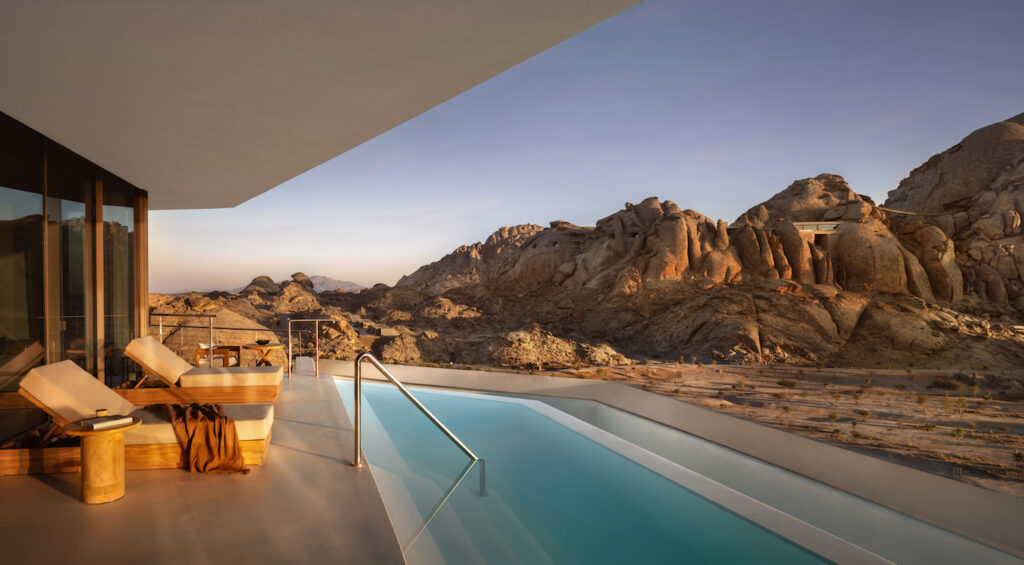
An excursion guaranteed to bring this home to the Red Sea visitor is a jaunt to Desert Rock Resort. Found about a 40-kilometre drive inland from Shura Island, this exceptional sanctuary—owned and managed by Red Sea Global Hospitality, the same home-grown group as Shebara—isn’t visible as you approach by car, so subtly does its uncanny architecture camouflage it amongst the granite peaks of the mountainous desert valley in which it lies.
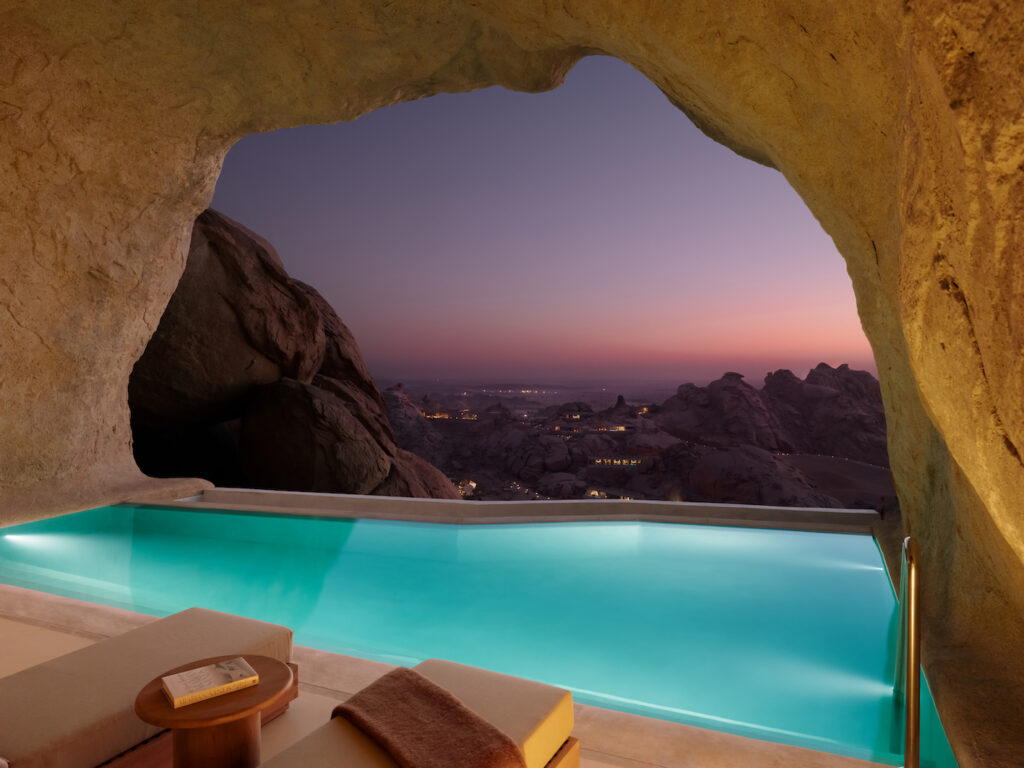
Many of the rooms at this ultra-luxe hideaway dangle from rocky ledges, are sandwiched between cliff crevices or are embedded like caves in the interior of the mountains, connecting guests intimately with the landscape. For the ultimate retreat, a three-bedroom Royal Villa is hidden away in an otherwise off-limits section of the valley. As I walk into my cave suite, I lightly brush my hands along the speckled rock wall as I’m compelled forward by the aquamarine water of my private infinity pool, contrasting with the camel-coloured desert punctuated with dark volcanic mountains.
Desert Rock actively encourages exploration and adventure. Reaching a strategically placed sundowner spot called The Observatory involves crossing a cable suspension bridge (don’t dare look over the edge) and then climbing 600-plus steps on a steeply winding boardwalk that’s bolted into the rock face. The exertion is worth it for the aptly named 1001 Stars mocktail—made with a base of pineapple-infused vanilla tea—that awaits those who make it, and get to enjoy the drink as the sun sets and the first star shimmers overhead in the darkening sky.
Once the darkness of the night has fully blanketed the property, it’s time to head to another of the resort’s rooftop perches for a lesson in Arab astronomy. We easily find Orion, one of the most recognisable constellations in the night sky, but the story passed down through ancient Arab tradition says the figure is not of a man hunting, as the Greeks told the West, but a woman wearing a belt of pearls caught in a tragic love story.
Conservation at its Core
Each of the Red Sea resorts has its own distinct personality, but what threads them all together is the region’s overarching, unwavering focus on sustainability to preserve the very reason why travellers visit this destination in the first place: its profound and immense natural beauty, and deeply ingrained cultural singularity.
Preservation of both is foremost in the mindset of its custodians. Less than one percent of the region’s land is set to be developed, and visitor numbers will be capped. Operations are powered by wind and solar energy (the latter is obviously not in short supply in Saudi Arabia) and high-end electric vehicles, such as blue- and coral-coloured Mercedes- Benz EQS, provide guest transfers on land.
The Red Sea destination promises barefoot luxury that leaves a light footprint, redefining what an upscale travel experience can be. This new vision of luxury remains firmly rooted in faultless service and astounding architectural design, but also weaves in a profound connection to place and the thrill of experiencing it just as the world is starting to sit up and take notice. Few places on the planet combine extraordinary natural beauty with such ambitious aims.
Getting There
As visitors arrive at Red Sea International Airport (RSI), they are welcomed with a warmth that embodies the region’s spirit of “Hafawa”—a core Saudi cultural value which can be summed up as generosity and a cordiality towards guests. Travellers are then transported to their resorts through carbon-neutral mobility options across land, sea and air.
Red Sea International Airport welcomes direct flights from Riyadh, Jeddah, Dubai and Doha, and one-stop connections from major European cities including London, Paris, Rome, Milan, Berlin, Frankfurt, Barcelona, Madrid, Almaty and Moscow: the destination is quickly becoming one of the most accessible escapes in the region. From RSI, Shura Island is just an hour’s drive across Saudi Arabia’s longest overwater bridge, linking guests directly to the vibrant hub of the Red Sea.
For more information, visit: visitredsea.com