The tented environs of The Oberoi Vindhyavilas, Bandhavgarh, provide the base for an enthralling expedition in search of Royal Bengal tigers.
The 4am alarm nixed that jetlag-busting night’s sleep I so craved, but it’s ensured that the jeep on whose raised back seat I’m now perched is third in a queue of 20, drawn up outside Bandhavgarh Tiger Reserve in Madhya Pradesh, central India.
“Not too bad, not too bad,” remarks Soulin Chakraborty, a senior naturalist with The Oberoi Group and our guide for the day, his words competing with the shrill chatter of monkeys, a cacophony of exotic birdsong and the Dussehra festival music drifting over from a nearby village (festivities start at first light here).



Having devoted the first two days of an eight-night, tailor-made itinerary organised by Abercrombie & Kent to exploring the Indian capital, it’s now time for the wild card of the programme: my first safari in search of the feline kingdom’s most imperious beasts.
The previous day’s journey here, following a domestic flight from Delhi to Jabalpur, had already offered a tantalising introduction to the pursuit: at one point during the four-hour drive, alarm calls emanating from the forest prompted several vehicles to congregate at the roadside—my first intimation of just how important the ability to interpret the sounds of the Indian wilderness would prove over the coming days.
The drive takes us along a frayed ribbon of suspension-testing Tarmac, through villages in which the temporary temples erected for Dussehra bring splashes of vivid orange to the roadside. Water buffalo, wandering cattle and the occasional precariously laden motorcycle make for an eventful road transfer. All of which makes the arrival at solid oak, imperious gates of The Oberoi Vindhyavilas, Bandhavgarh, around 900km south-east of Delhi all the more striking.A tented luxury retreat, its air-conditioned quarters sprinkled around a hunting lodge-inspired hub containing a library, lake-facing dining facilities and a bar (the latter replete with fine Indian whiskies), it offers an immediate and striking contrast to the frenetic urban milieu from which you’ve travelled. Private gardens (some with plunge pools) and the restorative ministrations of an elegant spa add further to the appeal, but the principal draw here is that the gates of Bandhavgarh Tiger Reserve are a mere 20-minute drive away.

Which brings us back to Chakraborty’s excitement at being so near the front of the queue. Tiger spotting in the centre of the subcontinent’s largest country, you see, is an entirely different enterprise to the more popular form of safari that takes place several thousand miles to the south-west. During a jaunt in, say, the Serengeti or the Maasai Mara (especially during the Great Migration), exotic wildlife is served to you on a platter. You climb into a land cruiser, leave camp and enter a world of visible fauna that calls to mind a lavishly illustrated children’s encyclopaedia.
Here, conversely, you, your guide, your driver and a forest guard, all suitably attired in khaki fatigues and camouflage snoods, creep through the jungle, constantly vigilant for clues to your quarry’s whereabouts. The first few jeeps to pass through the reserve’s gates at dawn have first dibs on the paw prints left overnight in the sandy tracks that score the forest floor, before they’re obliterated by tyre tracks over the course of the morning.
Those prints offer an abundance of clues: at what point on the path (tigers favour the man-made tracks, curiously) the creatures trailed off into the wilderness; in which direction; the gender of the creature that made them (female prints are more elongated, with longer toe indentations). All this is taken into account along with guides’ specific knowledge of the forest inhabitants’ mating habits. Some guides even take tigresses’ oestrus cycles into account, scanning tree trunks for fresh, wet spray patches where one has tried to entice a mate with her pheromones.
Claw marks we see on a tree trunk suggest that a male tiger has recently been here: the stripped bark, about six feet up from the ground, reveals pinkish-red wood within (the exposed wood darkens within hours). Alarm calls from other creatures, including monkeys, deer, wild cattle and antelopes—which guides have learned to recognise as they echo around the forest—often prompt our driver to put pedal to metal and head for their source.
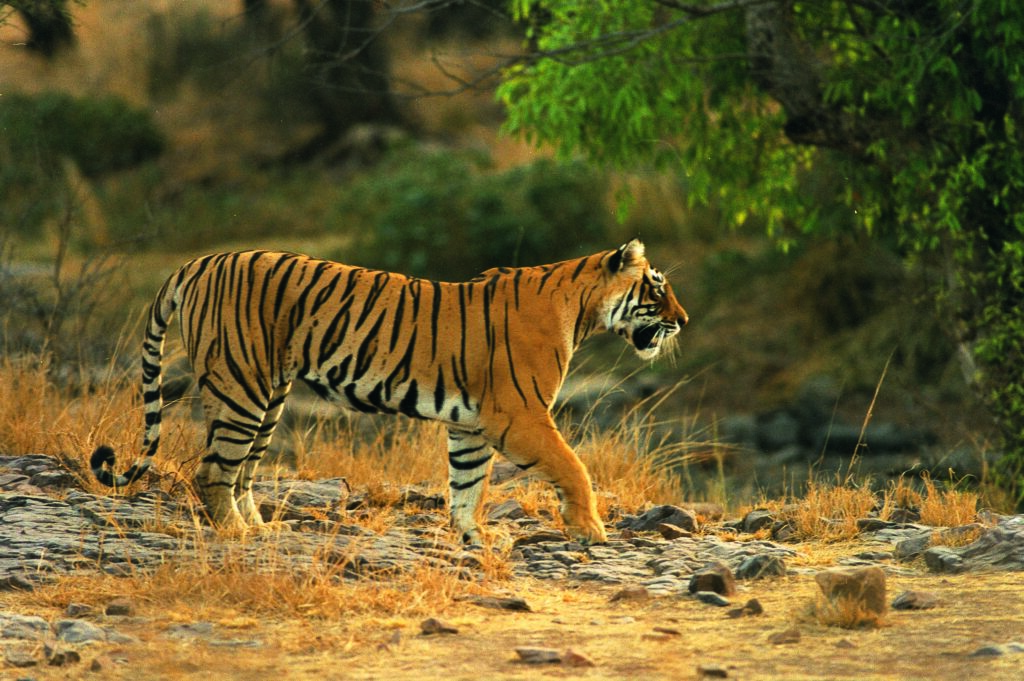
Climate is another variable. During India’s sweltering months, guides are more likely to investigate watering holes when no other clues are on offer, while fresh scat, disturbed undergrowth and the movements of prey animals also offer clues.
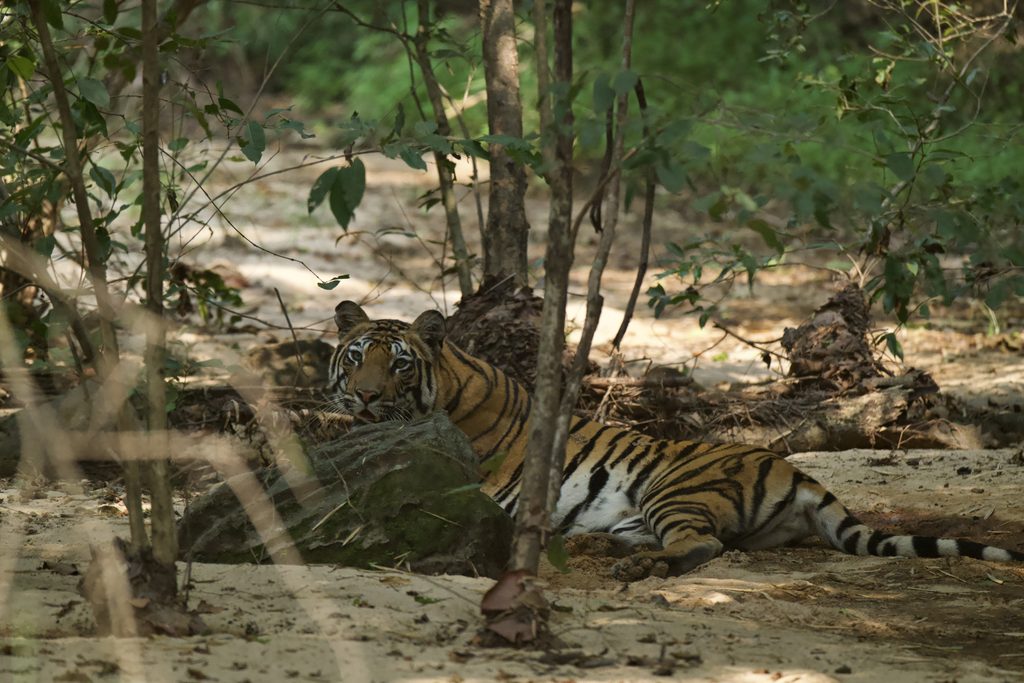
Eventually, our first sighting comes mid-morning, when shouts of “Baagh! Baagh!” (Hindi for “tiger”) emanate from a neighbouring jeep, alerting us to the animal’s presence. Its passengers’ deft interpretation of the clues, aided by a stroke of luck, has paid off. A surge of jeeps descends on the scene and, after a frenetic game of vehicular dodgems, everyone secures a ringside seat to a female tiger reclining in the undergrowth metres from the track. Awed murmurs mingle with the whirring of extending telephoto lenses.

The rarity of such a sighting makes one all the more compelling. And, this animal’s scarcity is, of course, a major factor in this being such an attritional pursuit: one involving constant vigilance and the weighing up of endless variables, metrics and clues. There are something like 135 to 165 tigers in this reserve, spread over around 1,536 square kilometres. The global figure is now approximately 5,700, having been estimated at 100,000 a century ago (India accounts for around 70 per cent of them). In India alone, a population once estimated at around 40,000 fell to fewer than 2,000 by the early 1970s, decimated by hunting, poaching and habitat loss.
Since then, concerted conservation efforts have helped numbers recover. “The National Tiger Conservation Authority provides funds, manpower, forest guards, anti-poaching initiatives and monitoring, helping the numbers grow slowly,” notes Chakraborty. Is there no temptation to use GPS systems or drones to locate them? Chakraborty gives me an incredulous look.“It’s no fun if you know where they are. You might as well go to a zoo.”

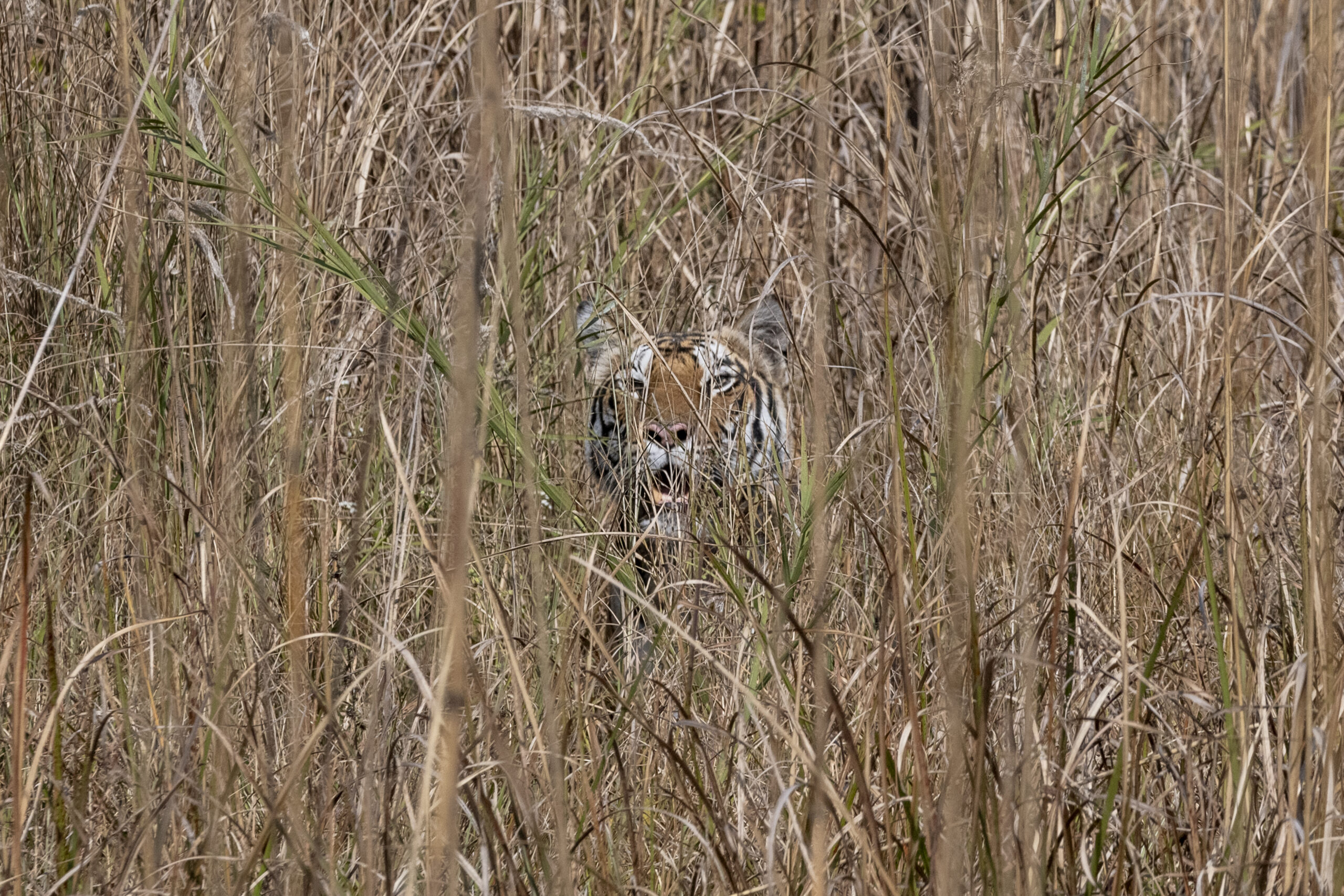
Our second sighting of the day vindicates his words. Tracking methods and simian warning calls have brought us to a spot where Chakraborty’s impressive mimicry of a tiger’s guttural, ground-shaking, almost bovine moan may have been a factor in drawing “D1”, a dominant male associated particularly with the Khitauli zone, towards us. His imperious gaze fixed on our jeep, D1 follows us down the sand track for 100 metres or so, spittle visible, hanging from his jaws, through binoculars, before swaggering off into the thickets. It’s a few seconds of life made all the more special by how difficult it was to come by.
UK Abercrombie & Kent (www.abercrombiekent.com; 03301 734 712) offers an 8-night tailormade India itinerary from £6,295pp, based on two sharing, including domestic travel, private transfers, sightseeing and guiding, and accommodation on a B&B basis at The Oberoi New Delhi; The Oberoi Vindhyavilas, Bandhavgarh; The Oberoi Rajgarh Palace and The Oberoi Amarvilas, Agra.