
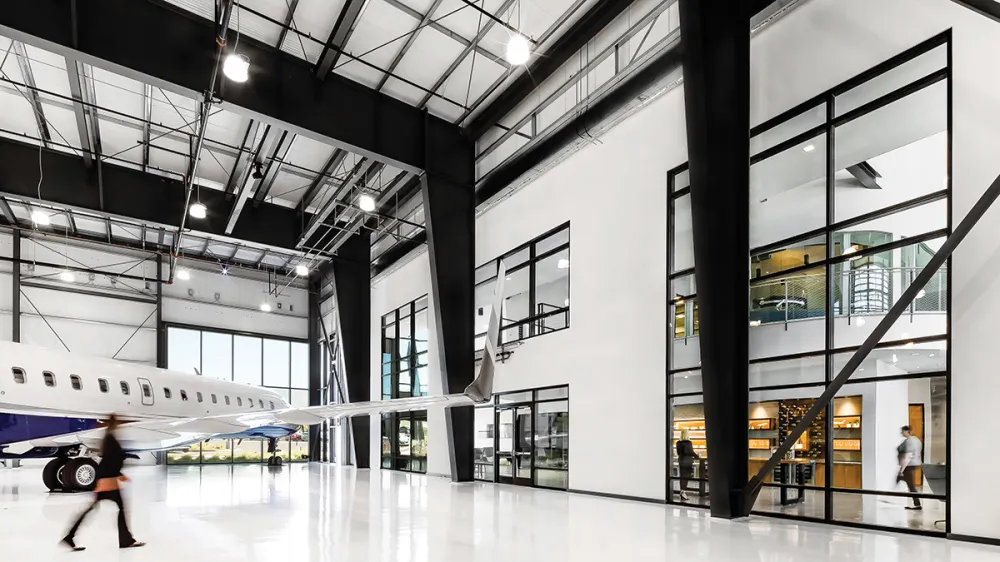
From exclusive terminals to upgraded crew amenities, private jet operators are reshaping their offerings.
Once viewed as little more than refueling and maintenance stopovers, fixed-base operators (F.B.O.) are being transformed from facilities with spartan waiting rooms and drip-coffee machines to ultra-swank private enclaves. Clay Lacy Aviation’s new complex at John Wayne Airport in Orange County, Calif., for example, spans nearly 4,000sqm of office and terminal space, with garden-accented lounges and over 13,000sqm of hangars. On a more intimate scale, the Coeur d’Alene airport in Idaho is home to StanCraft’s Jet Center, designed by an internationally renowned wooden boatbuilder and pairing modern F.B.O. conveniences with rustic spaces such as the Hardwood Coffee Café.
These enhancements are being driven by increased demand for private jets alongside rising expectations from customers seeking five-star services. According to the Insight Partners, a New York–based research firm, the global F.B.O. market will grow from $25.55 billion (around €21.53 billion) last year to $41 billion (around €34.56 billion) by 2031. In response, today’s most sophisticated facilities offer spa-like environments complete with gyms, showers, fine dining, conference suites, and upgraded crew amenities.
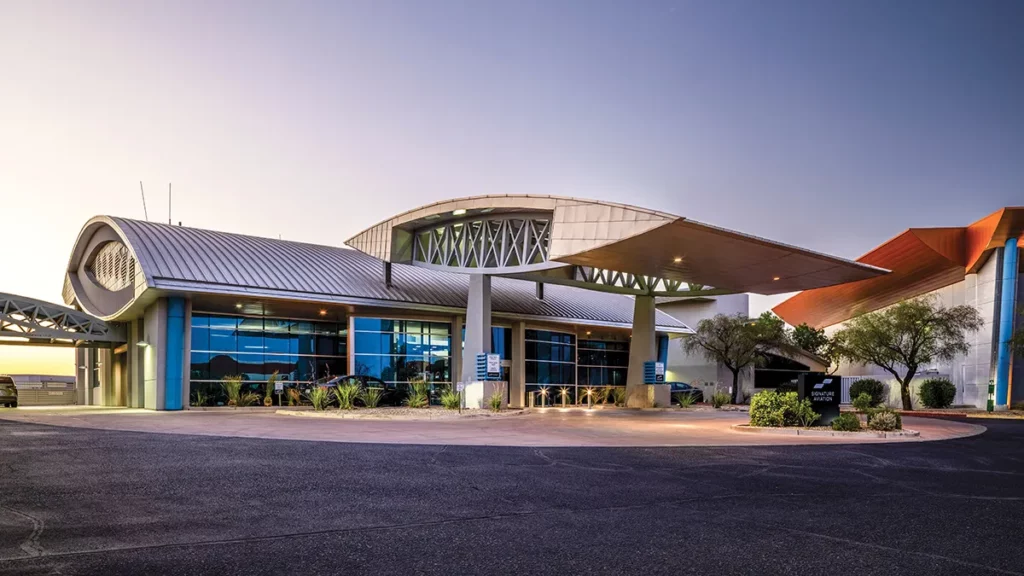
One of the biggest players in the F.B.O. makeover game is Signature Aviation, which was purchased in 2021 for $4.7 billion (around €4 billion) by a consortium including Blackstone, Global Infrastructure Partners, and Cascade Investments. With about 80 construction projects underway, Signature recently opened its showpiece terminal, PBI North in West Palm Beach, Fla. Among the prime features are a stained-glass art installation, multiple guest areas, and a family lounge. Signature’s goal is to establish a “hospitality-forward” ethos across its 200-plus locations in 27 countries. Derek DeCross, the company’s chief commercial officer, says its “scale gives travelers a consistent experience wherever they leave from or land.”
Similarly, fractional provider Flexjet has embarked on a series of new private terminals for owners of its elite Red Label aircraft. Flexjet, like several peers, reported record demand in the last quarter of 2025, while the fractional model—where owners purchase shares of an aircraft—was up 24 percent for the year. Six new Flexjet F.B.O.s are in the works, including a $36 million (around €30.33 million) outpost in Scottsdale, Ariz., and an extravagant European gateway in Farnborough, England. “You can have a fine experience at an F.B.O., but we want to go beyond that,” says Flexjet C.E.O. Andrew Collins. “We want to control the customer experience in the air and on the ground.”
ACI Jet exemplifies how even small operators are making outsize investments. While its personal touch began more than a decade ago with complimentary Negranti ice cream, ACI has experienced growth that necessitated the construction of its modern 91,000-square-foot (around 8,500sqm) headquarters, which opened in 2021 at its San Luis Obispo, Calif., location. Its latest project is a $125 million (around €107.5 million) 32-acre redevelopment—also at John Wayne Airport. “At all our facilities, we want to do something all the way—something with a real ‘wow’ factor,” says Bill Borgsmiller, who founded the company in 1998. “But it still needs to feel curated, personal, and passionate—not corporate.” The modern terminal will have sleeping rooms, conference rooms, a private bathroom with shower, entertainment areas, and over 90 hangars organized by jet type.
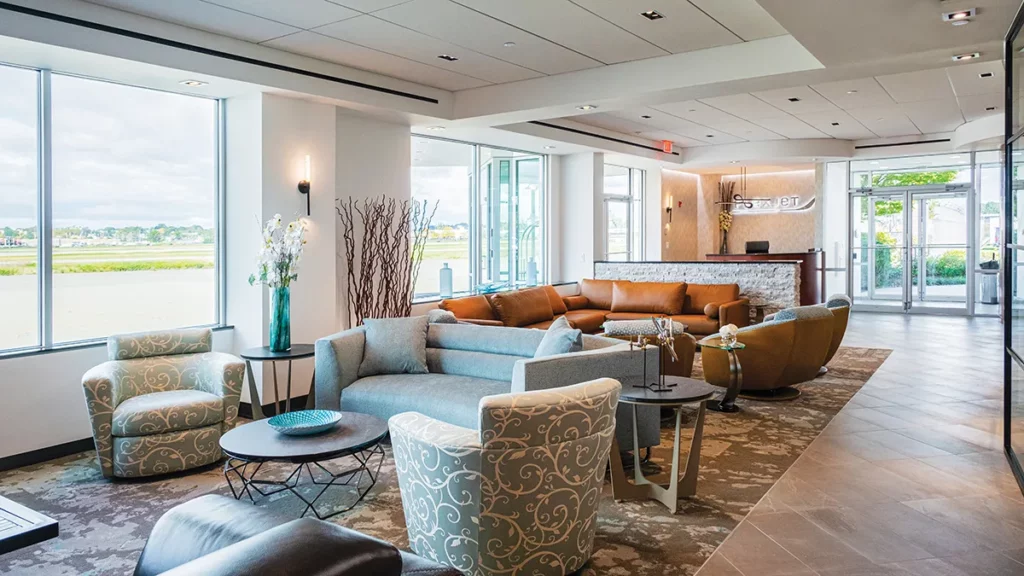
In 2023, Magellan Jets opened its first private terminal at Laurence G. Hanscom Field in Bedford, Mass., strictly for its clients. “Our core business is not selling fuel. It’s serving people,” says Anthony Tivnan, Magellan’s founder and president. Despite no financial metrics to track the return on investment, the Bedford facility has created so much goodwill that Magellan is now considering additional locations in high-traffic markets such as South Florida, Texas, and the New York metro area.
Large and boutique operators alike are differentiating themselves through modern design, personalization, and luxe amenities aimed at an increasingly discerning clientele. That demand continues to fuel private aviation’s long-term growth—and the economic slipstream allowing these companies to stretch their wings. Daniel Cote
Top: ACI Jet’s headquarters in San Luis Obispo, Calif., connects a modern glass-fronted terminal with a showroom hangar offering views of the jets inside.
Terminal Heat
Skipping airport chaos might be the most coveted luxury in travel. That’s the promise behind PS, the Los Angeles–based private-terminal concept that lets crowd-weary travelers bypass the commercial crush. Instead, clients retreat to airport suites—with private rooms, fine dining, and on-site T.S.A. and customs clearance—before being chauffeured to their aircraft.
PS currently operates terminals in Los Angeles (LAX) and Atlanta (ATL), and Dallas-Fort Worth (DFW) is scheduled to open later this spring. The company is also completing renovations on the historic Pan Am building near Miami International Airport. Built in 1963 during commercial flight’s golden age, this midcentury-modern landmark was Pan Am’s regional headquarters for decades but has not been in use since the late 1990s. “When we looked at it, it was love at first sight,” says Amina Belouizdad Porter, C.E.O. of PS. “The way it was laid out worked really well for us.
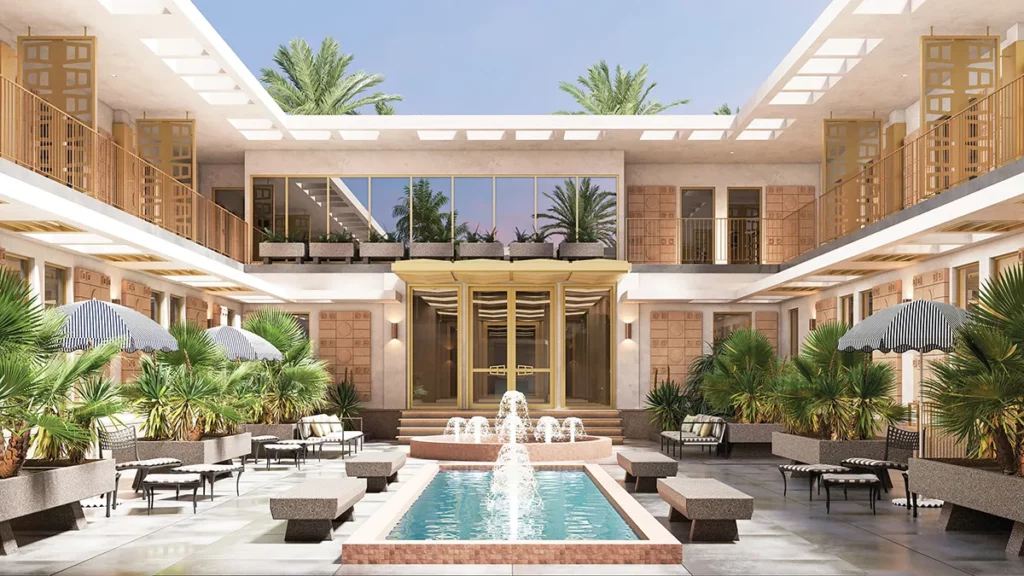
The 30,000-square-foot (around 2,700sqm)sanctuary, originally designed by Steward and Skinner, was inspired by the U.S. Embassy in India, gaining the nickname “Miami’s Taj Mahal.” While the building had limited structural appeal for an international airport, the PS application was a good fit. Aside from demolishing several walls, historical restoration-specialist and local architect Richard Heisenbottle left most of the style-defining construction intact, while PS interior designer Cliff Fong used contemporary soft surfaces to instill a modern sensibility. The team also renovated the interior courtyard’s reflecting pool.
According to Belouizdad Porter, the aim is for it all to “feel like a residence [in] like Coral Gables or West Palm Beach,” though she adds, “You’re also unmistakably in this Pan Am–era building. It will always have this unique sense of place.” PS MIA will open later this year. Michael Verdon