In the latest edition of his Confessions of a Wine Collector series, our wine expert explains how the right glass can transform the way a wine tastes and smells—and why great Champagne should never be served in a flute.
Between the cellar and the palate, three things intervene: the bottle, the decanter and the glass. I have already confessed my views on decanting—when it helps and when it harms. Glassware is the quieter question, but no less important. Some stems flatter a wine; others expose it, and quite a few simply get in the way. I have learnt that the glass you choose can be as decisive as the wine you pour into it.
I have never been interested in glassware as ornament, or in stems chosen because they look reassuringly expensive on a table. I am interested in the shapes and designs that actually help you taste. Sometimes that means using a glass that lets a great wine speak more clearly. Sometimes it means choosing a neutral, robust stem that disappears and lets the wine take centre stage. And sometimes it means resisting the urge to treat every grape variety as an excuse for another piece of glassware.


The industry does its best to encourage exactly that habit. The dedicated wine-glass sector is now worth roughly $1.2 billion a year globally, while the wider glassware market is approaching $10 billion annually. There is real money in convincing people every wine needs its own glass.
The cheat glass
If decanting is the question of how much air a wine deserves, glassware is the question of how much help it gets. I first got into serious glassware, appropriately enough, with a glass that tilts the odds in your favour.
For red wine and many whites, my glass of choice is called Sensory. It was designed by Roberto Conterno of the great Barolo producer, Giacomo Conterno, together with a leading German glassmaker. At first glance it looks like a generous Burgundy bowl on a slender stem. In the hand, it feels almost weightless. On the table, it seems modest enough.
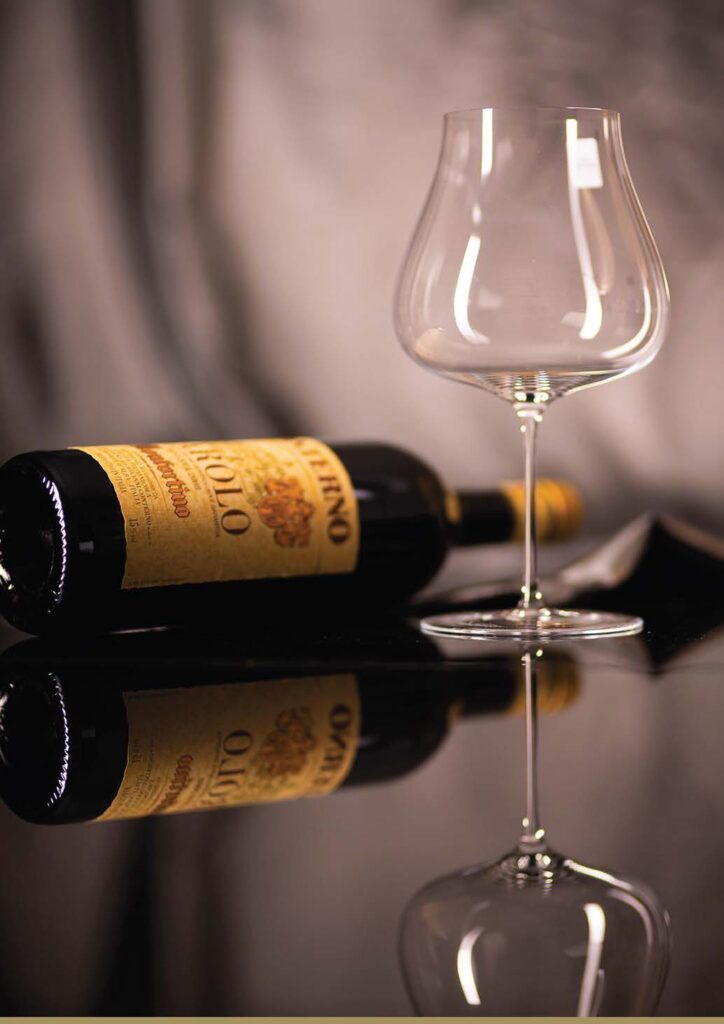
Once you use it, that modesty disappears. Sensory has a broad base, a carefully curved bowl and a subtly narrowed rim that together amplify aroma. Details that are muted in a standard glass—fine herbal notes, delicate florals, hints of spice—come through much more clearly.
This is why I call it the cheat glass. If you had to call a wine blind, this is the glass you would want. It does not make a bad wine good, but it does help a good wine show more of itself. If you care about nuance, this is not a minor advantage.
What glasses really do
Glasses are often treated as neutral vessels. They are not. Change the glass and you change the wine. Try the same bottle in a thick restaurant goblet and then in a fine-rimmed bowl—you will see at once how much shape alters perception. Aroma can tighten or expand; texture can seem coarse or graceful. The liquid in the bottle is unchanged; how it reaches you is not.
In practice, only three things matter. First, the size and shape of the bowl: a broad base gives more surface area for air and more space for aromas to gather, while a tighter bowl focuses the nose and a flared rim lets it disperse. Second, the diameter of the opening: a wide rim sends the wine across more of the tongue at once; a narrower one can tilt perception of acidity, tannin and sweetness. Third, thickness and weight: a thin, light glass disappears at the lip, whereas a thick, heavy rim imposes itself and blunts precision.
Even in whisky, glassware is not incidental. A bulbous nosing glass with a narrower opening traps and releases volatile compounds more gently, letting you pick up complexity without being dominated by alcohol. A wide tumbler may look reassuringly solid, but it can throw away half the nose. Once you see how much the glass changes things, it becomes very hard to believe that any glass will do for serious wine.
Thin glass, better flow
Thickness is rarely discussed, but it matters more than most people think. Many vignerons and serious drinkers are devoted to stems such as Zalto not only because of the shape, but because the glass itself is remarkably thin. A very fine rim almost disappears at the lip. You feel the wine rather than the vessel. More importantly, the liquid travels cleanly onto the palate and toward the mid-palate, instead of being checked by a heavy edge. Texture becomes easier to read; balance easier to judge.
By contrast, thick rims impose themselves. They can make a wine feel clumsier than it is, as though tannin, acidity or sweetness arrive in a lump rather than in sequence. That is one of the hidden reasons serious wines seem less articulate in ordinary restaurant stemware than they do in a great glass at home. There is a price for this finesse: thin glasses break, sometimes heartbreakingly often. But once you have grown used to that near-frictionless contact, it is very hard to go back.
Hand-blown, factory-made, glass, crystal
Hand-blown glasses carry the romance; most of us, most of the time, drink from machine-made ones. Both have their place. Hand-blown stems are often lighter, thinner and more graceful, with a bowl and rim that can feel almost immaterial in use. Collectors and vignerons prize that finesse of contact. The drawbacks are obvious: fragility, cost and an unwillingness to tolerate the realities of a busy dining room, a party or a major event.
But good machine-made glassware is far more than a compromise. At its best, it brings a different kind of precision: consistency of bowl, rim, balance and clarity from one glass to the next. This matters enormously in serious hospitality, where a table of guests—or an entire room—should receive the same considered experience.
Stölzle Lausitz is a strong example of this approach. Its premium crystal stemware combines an elegant, fine-wine profile with the repeatability and resilience required by the world’s best restaurants, hotels and events. When you are serving hundreds of glasses in an evening, that consistency is not merely a logistical virtue; it is part of serving wine properly.
The same distinction applies to material. Plain glass is often more durable but usually thicker and heavier. Crystal—traditional or lead-free—can be made more finely and shaped more precisely, which is why so much serious stemware is crystal rather than basic glass.
Universal or specialised?
One of the more tiresome arguments in modern glassware is whether you should own one universal stem for everything or a small crystal forest of grape-specific designs. As usual, the sensible answer sits somewhere in between. A truly good universal glass is one of the great luxuries of the serious drinker, giving enough shape and finesse to handle a broad range of wines without making each bottle feel like it needs its own glass.
It is also true that some categories benefit from specialised stems. Champagne is the obvious example; whisky, in a different way, is another. My own preference is a compact personal toolkit: one or two excellent universals supported by a handful of more specialised glasses where shape clearly changes the experience. Beyond that, the returns diminish rapidly.
My everyday toolkit
Anyone who spends enough time with fine wine and spirits ends up with a personal toolkit of glasses. Mine is narrower than some people might imagine, but each choice has a reason. These are not rankings of glassmakers; they are simply the choices I make for particular bottles and particular moments.
For most red wines—and many whites—I reach for the Sensory glass. It suits structured, elegant wines—Pinot Noir, Nebbiolo, Barbera, Chardonnay, Grüner Veltliner and more. The broad bowl and finely tuned rim give the wine enough air and enough focus to show its architecture and its perfume at the same time. It is the glass I instinctively pick up when a bottle matters.
For many whites beyond Burgundy—Riesling, Loire Chenin, certain Italian whites—I use the Zalto Universal glass. It is very light, very thin and beautifully balanced. Universals are often a compromise; this one rarely feels like one. It is versatile enough to handle a wide range of styles without imposing itself and precise enough to serve serious wines without apology.
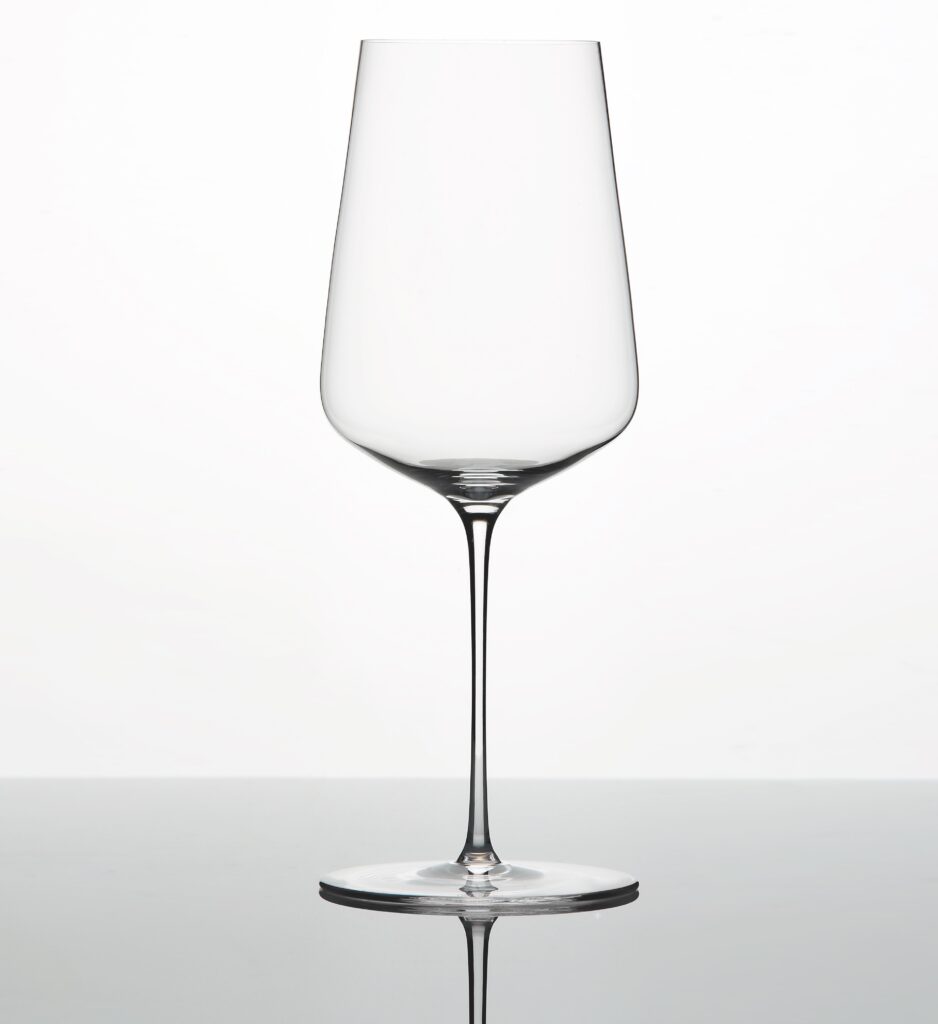
For sweet wines, I often use that same Universal glass. Many sweet wines are more delicate than people think; they benefit from space and a proper nose. When a wine is very sweet, however—concentrated Essenzia, certain Tokaji, very old Sauternes—I go back to a smaller tasting glass, akin to those I used in my wine exams. It keeps aroma, sugar and alcohol in check and makes it easier to taste rather than simply sip.
For whisky, I went a step further. I had my own glasses made, based on an 18th-century nosing glass design I saw in a museum. The original was beautiful but impractical to acquire in quantity. The modern incarnation preserves its essential shape: an hourglass form, with a wide base that rises inward to a narrower neck and a gently flared rim. It is an excellent glass for whisky. It allows the nose to develop in layers and protects it from being overwhelmed by alcohol vapour. Once you have used it for serious nosing, most tumblers begin to feel like blunt instruments.

Champagne deserves better
I will not drink Champagne from a flute. If I am in a restaurant and the choice is between a flute and a decent white wine glass, I will take the white wine glass every time.
The flute is a theatrical object. Its narrow shape preserves bubbles and looks festive, but it suppresses aroma and gives complex sparkling wine almost nowhere to go. That may be acceptable for simple, cheerful sparkling wines where coldness and effervescence are the point. Prosecco can live quite happily in a flute. Great Champagne cannot.
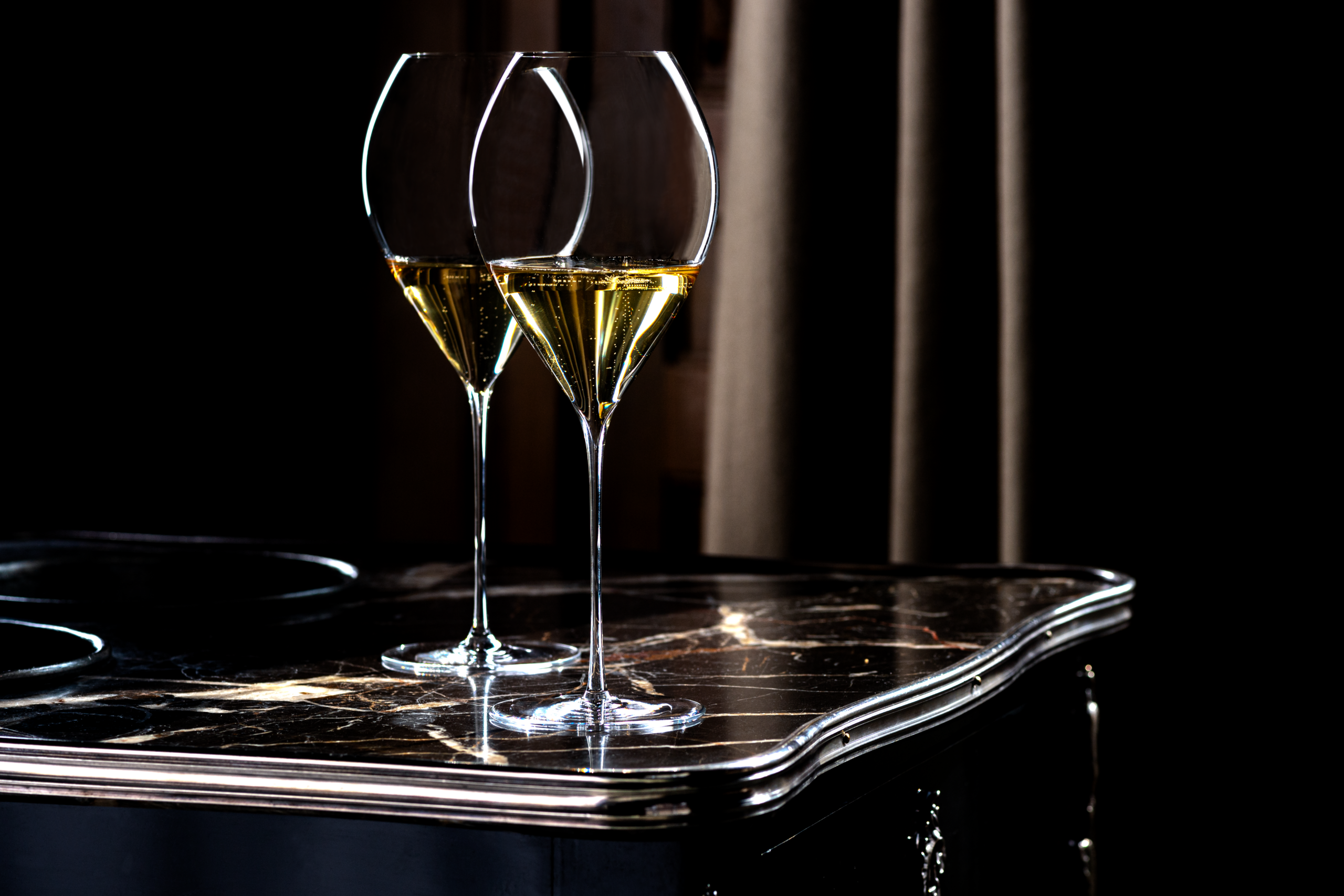
Complex sparkling wines need to be treated as wines first and sparkling wines second. The best white Champagne glasses are tulip-shaped, and if one is not available, a proper white wine glass is vastly preferable. A wider bowl allows the perfume to gather and the texture to show itself. It lets autolysis, fruit and age speak rather than reducing the whole performance to a string of bubbles.
Indeed, if you are faced with a genuinely poor bottle of Champagne, there is a case for doing exactly the opposite of what one should do for the great stuff: serve it brutally cold, in a flute, and drink it quickly. The temperature and the narrow glass will suppress much of what is wrong with it. But that is concealment, not appreciation. Any serious Champagne deserves better than concealment.
One small Champagne‑glass detail is worth mentioning. Many serious sparkling‑wine glasses now have a tiny, laser‑etched point or ring in the bottom of the bowl. It is a tiny, deliberate imperfection, designed as a nucleation site to help bubbles form and rise in a steady stream, rather than sulk around the glass. Few manufacturers draw much attention to it, but it is a quietly engineered effect: enough mousse to look lively and lift aroma, without turning the wine into froth, and just a touch of theatre built into the base.
For white Champagne, I use the Lehmann Jamesse Grand Cru glass, a tulip-shaped stem with a pointed lower section that encourages the wine to swirl and open. It preserves mousse but gives the nose room. Blanc Champagne with detail and finesse belongs in this shape, not in a narrow cylinder designed more to show bubbles than reveal aroma. For rosé Champagne, I use a larger Jamesse glass from the same maker, with a more generous bowl that gives broader, more vinous rosé Champagnes space to show.
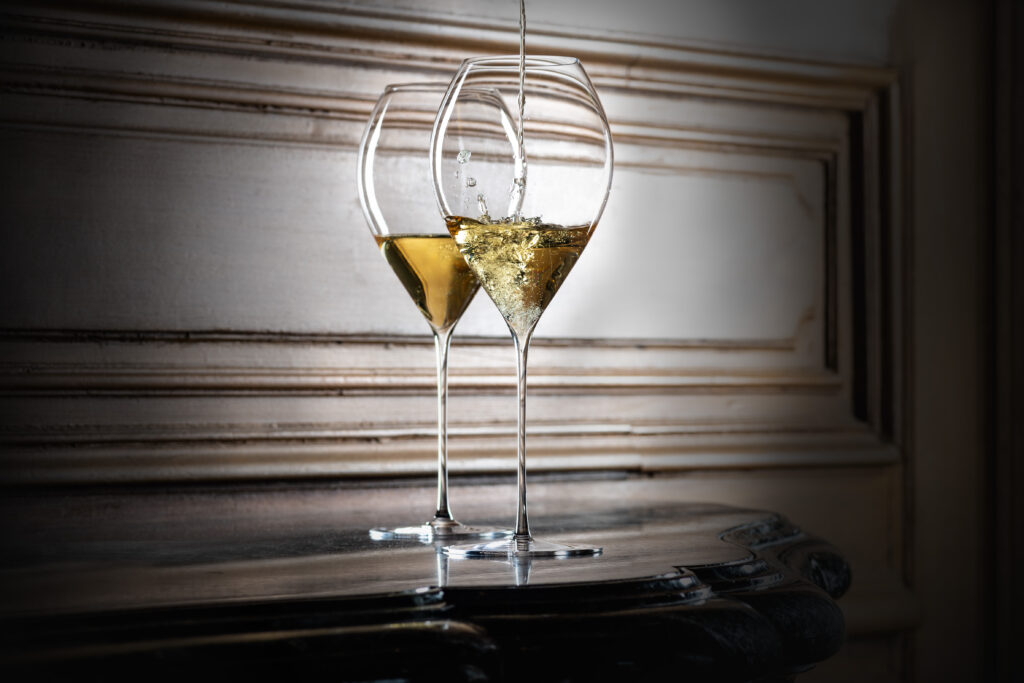
A Toast to Craftsmanship: Stölzle Lausitz x The Golden Vines
Glass choice is different when you are pouring for a handful of guests at home than when you are hosting a major event. At The Golden Vines Awards, we do not assess wines; we honour estates. But at the gala, we serve some of the world’s greatest wines, and every pour still deserves to be presented properly.
For that role, we work with Stölzle Lausitz, our Awards sponsor. Its premium crystal stemware combines the qualities that matter in serious wine service—clarity, balance and an elegant fine-wine profile—with the consistency required when hundreds of guests are being served in a single evening.
At that scale, consistency is its own form of precision. Every table should receive the same considered experience; every guest should be able to see, nose and enjoy the wine as its producer intended. That is not a compromise with connoisseurship. It is one of its more demanding expressions.
The task at Golden Vines is not to turn glassware into the evening’s protagonist. It is to ensure that exceptional wines are served confidently, beautifully and faithfully, from the first pour to the last. Stölzle Lausitz enables precisely that. Its glassware has the discretion of good service: it does its work so well that attention remains where it belongs, on the wine and on the estates we are celebrating.
At home, I may optimise for a specific bottle or a particular mood. At The Golden Vines, I optimise for fine-wine performance across an entire room. These are different disciplines, not different standards.

Theatre versus function
The wine world has a weakness for fetishising equipment. As with decanters, so with glasses: the more elaborate the shape, the more persuasive the marketing. There are stems that look as though they were designed by architects rather than by people who drink wine. Some are beautiful. A few are genuinely useful. Many are simply overthought.
I am skeptical of any glass that announces itself too loudly. If a design is so eccentric that your first thought is about the stem rather than the wine, something has probably gone wrong. Good glassware should sharpen perception, not distract from it. It should disappear into the act of drinking.
That is why I would always rather own a few very good glasses than an army of highly specialised ones purchased in the hope that each bottle might finally meet its destined vessel. There is a point at which connoisseurship slides into theatre. The serious collector should know where that line lies.
What to look for
If you are choosing proper glassware, ignore most of the marketing and ask four questions. Is the bowl clear and free of visual distortion? Is the rim thin enough that you barely feel it? Does the shape suit the wines you actually drink, rather than a hypothetical grape variety you rarely open? And is the material fine crystal or high-quality glass that will survive the way you use it?
If the answer is yes three times out of four, you are probably holding a glass worth owning. If all you are being sold is a story, a silhouette and a sense of insufficiency, you are probably not.
My rules
| Drink style | My glass of choice | Why |
| Red wine | Sensory | Magnifies aroma and gives serious reds real shape |
| White Burgundy | Sensory | Handles richness, reduction and texture beautifully |
| Riesling and many other whites | Zalto Universal | Precise, light, versatile and genuinely useful |
| White Champagne | Lehmann Jamesse Grand Cru | Preserves mousse while allowing the nose to open |
| Rosé Champagne | Larger-bowled Jamesse glass | Gives broader, more vinous rosé Champagnes room |
| Sweet wines | Zalto Universal, or smaller tasting glass for very sweet wines | Lets complexity show, but reins in extreme sweetness when necessary |
| Whisky | Bespoke 18th-century-inspired nosing glass | Layers the nose and controls alcohol better than a tumbler |
| Large-scaleservice | Stölzle Lausitz top stemware | Combines clarity, balance and an elegant fine-wine presentation with the consistency needed to serve exceptional wines beautifully at scale |
The final confession
The longer I collect wine and spirits, the less interested I become in owning things for the sake of owning them. That applies to glassware as much as to bottles. The right glass is not a trophy; it is a tool.
If there is one confession worth making: fine glassware matters more than most people realise, and still less than the manufacturers would have you think. The best stems do not perform miracles. They simply remove obstacles between you and the drink. In fine wine, that is often miracle enough.
Lewis Chester DipWSET is a London-based wine & rare spirit collector and writer, member of the Académie du Champagne and Chevaliers du Tastevin, co-founder of Liquid Icons and the founder of the Golden Vines® Awards. He is also Honorary President and Head of Fundraising at the Gérard Basset Foundation, which funds diversity & inclusivity education programmes globally in the wine, spirits & hospitality sectors. The Golden Vines® 2026 will take place in London, UK between 6-8 November 2026, recognising the world’s best fine wine estates as voted by hundreds of fine wine professionals. Please register your interest for tickets on the website: liquidicons.com/work/golden-vines-awards.