Motoring’s Gilded Age continues to glitter, blurring genres and exploring technological frontiers.
Landmark human achievements in any given field, like the stars above us, emerge in clusters. The telephone, the phonograph and the electric light bulb were all invented within just 43 months of each other in the late 19th century. Chinatown, The Godfather Part II, One Flew Over the Cuckoo’s Nest and Taxi Driver all hit the silver screen within a two-year period in the mid-’70s.
Similarly, the automotive realm is experiencing a purple patch right now, delivering a benchmark crop of contenders for Robb Report’s top automotive honours. The remarkable range of vehicles we’ve driven of late defy easy classification, for various reasons. One is the blurring of genres—between hypercar and supercar, or SUV and grand tourer. Another, of course, is electric powertrains offering grounds for divorce between performance and traditional mechanical layouts. The plot may be denser, but it is more of a page-turner than ever before. And the machines below left us starstruck: albeit not always unequivocally.


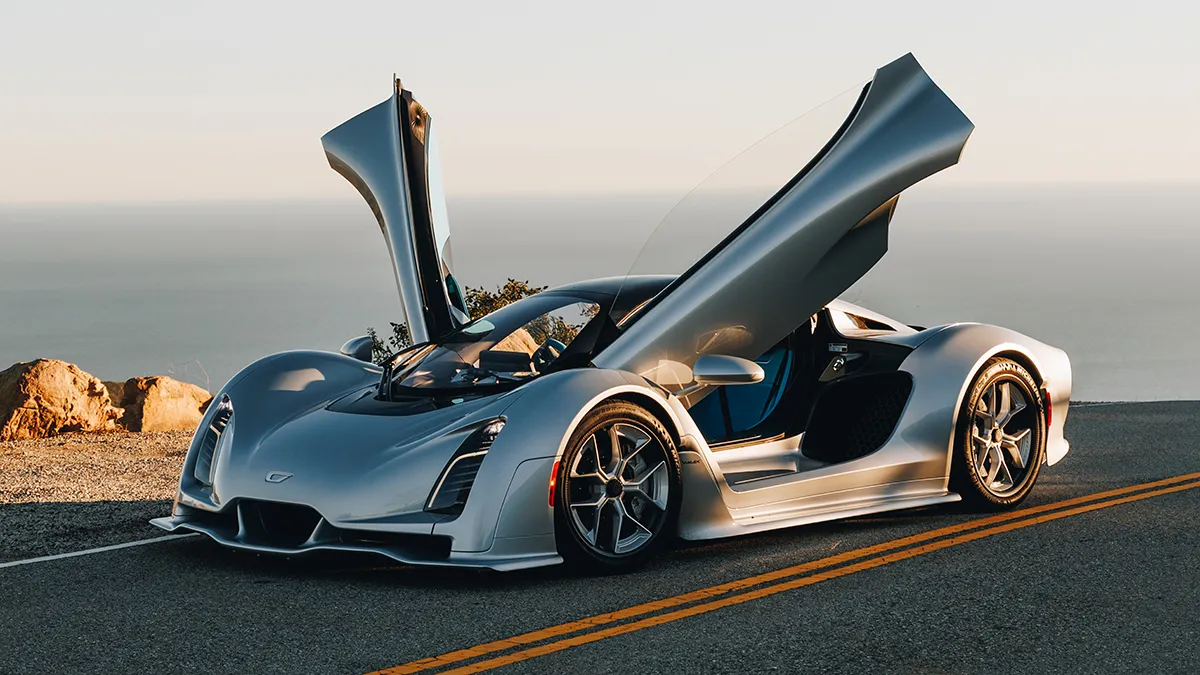
Best Hypercar: Czinger 21C V Max
The hypercar designation, if based on output alone, has become increasingly slippery, as four-door models with room for groceries now crack four figures of horsepower. Yet the term was coined to define a vehicle that defied the perceived limits of power, design, performance and industry impact.
By that measure, the Czinger 21C V Max is the new standard-bearer for the category. Of course, the 1,600 kg (dry weight) hybrid has muscle, rocketlike acceleration, and benchmark agility the class demands. A 2.88-litre, twin-turbo V8, capable of 11,000 rpm, pairs with two independent front motors for a combined 919 kW. (A third electric motor charges the two 800-volt batteries.)
That setup pushes the glasscanopied tandem-seat milestone from zero to 100 km/h in 1.9 seconds on its way to a top speed of 407 km/h. The powertrain works with electronically adjustable damping, a brake-bywire system, and electrohydraulic steering—a potent mix that helped the high-downforce variant of the 21C set record production-car lap times at five circuits, including Laguna Seca.
Yet what secured the 21C’s place on the hypercar pedestal is the breadth of its innovation, from the Southern California marque’s AI-driven design approach to its 3D printing to its robotic-assembly process, all developed in-house through parent company Divergent Technologies. With the 21C, Czinger’s goal to reimagine the entire manufacturing landscape comes into sharp focus. From around €2 million
Best Hybrid Hypercar: Bugatti Tourbillon
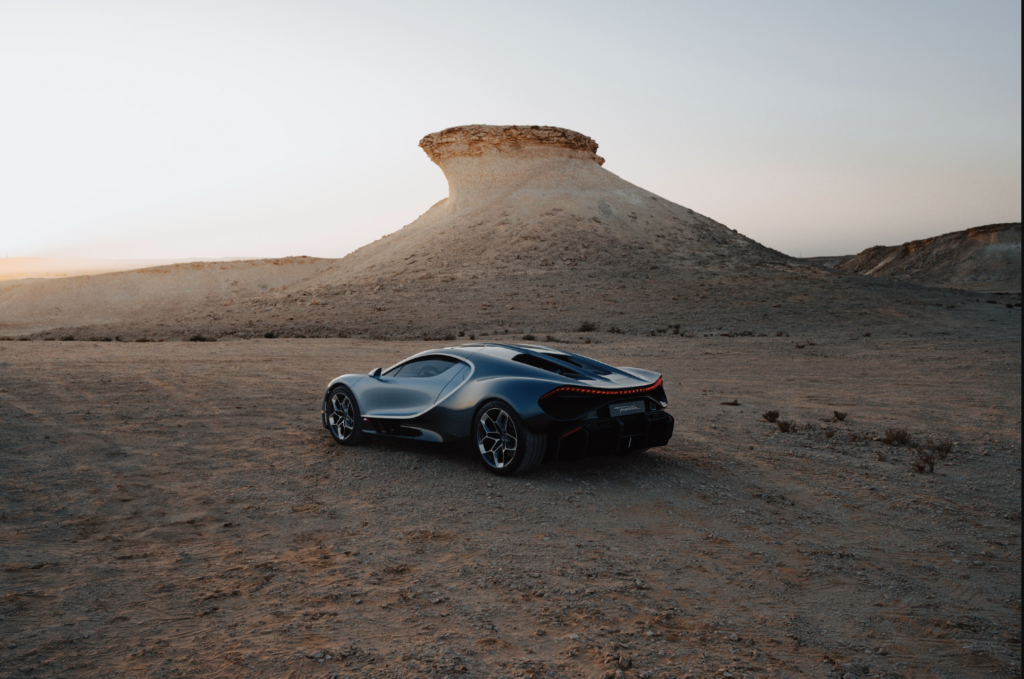
We could wax lyrical about the 8.3-litre, V16 engine that replaces its predecessor’s 8.0-litre, W16 unit. We could gush over the trio of electric motors that augment said powerplant, escorting Bugatti into the post-petrol epoch for the first time. We could even rave about the Tourbillon’s more aerodynamic body, lower roofline and wider horseshoe grille—somehow more in keeping with the car’s poisedto- pounce stance.
But realistically, the major talking point around the Chiron’s successor is always going to be the feature which gives the car its horological moniker: a skeletonised, titanium-and-sapphireglass instrument cluster inspired by a mechanism designed to improve accuracy in mechanical watches, invented by Abraham-Louis Breguet in 1801. “Beauty, performance, and luxury formed the blueprint for the Tourbillon,” Mate Rimac, Bugatti- Rimac’s CEO, told Robb Report during a preview in Berlin. “What we have created is a car that is more elegant, more emotive and more luxurious than anything before it.”
Performance borders on the absurd, with zero to 100 km/h dispatched in around 2.0 seconds and a top speed beyond 445 km/h. The vehicle being named after an innovation which struck a new deal with physics is fitting. From around €3.8 million
Best Fully Electric SUV: Mercedes-Benz G 580 (With EQ Technology)
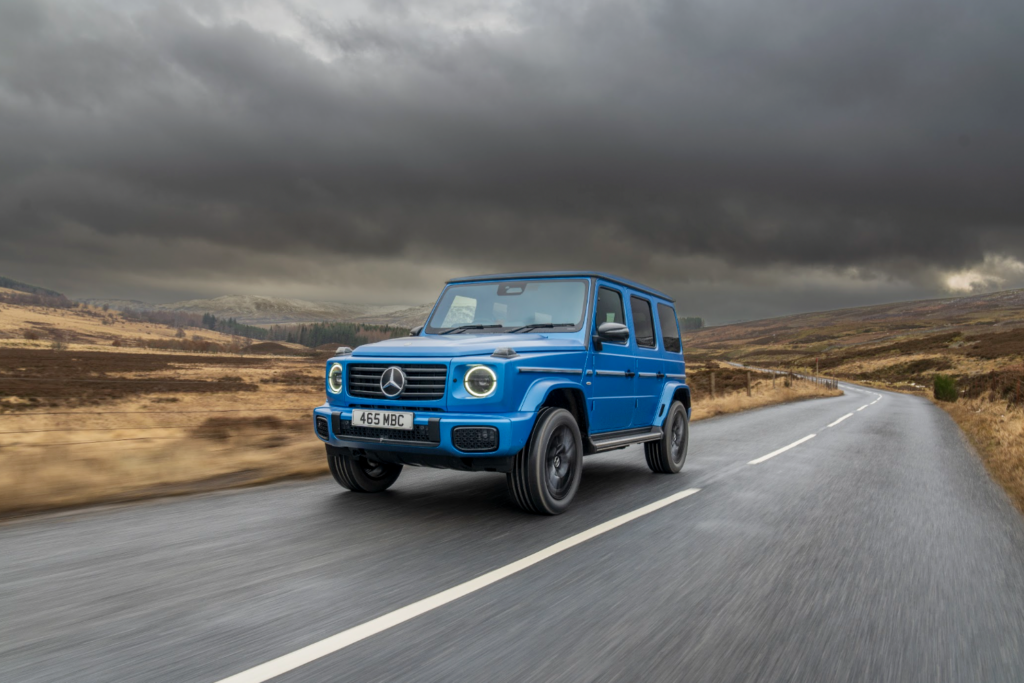
Ladder-frame attitude, exposed door hinges, a stance that looks permanently braced against high wind and higher expectations… All present and correct. And what a delicious paradox it is (look away now, combustion purists) to see a G-Class Mercedes’ Bauhaus-brutalist silhouette powered from A to B with the almost monastic hum of electric motors: one per wheel, to be exact, with two-speed transmission also bolstering the genuine off-road credentials at which that imperious shell hints.
Electrification, so the anti-electric lobby says, sands away motoring’s soul. Maybe—to a degree—on tarmac. The G 580 is proof, though, of how conducive instant torque is to driving over the rough: smoother traction control, fewer wheelspins and better micro-adjustments mid-climb. And yet on-road, thanks largely to dynamic torque management and a low centre of gravity, the Electric G 580 behaves with improbable poise. The 432 kW and 1,164 Nm of torque afforded by that quadrant of motors power it from zero to 100 km/h in a nonchalant 4.7 seconds, with speed limited to 180 km/h. Despite its considerable weight of 3,085 kg, the vehicle’s official range is up to 473 km, while its 116 kWh battery pack will rapidly charge at up to 200 kW to give a 10 to 80 percent charge rate of 32 minutes.
Inside, it remains unmistakably G-Class: still square-shouldered, standing to attention, but otherwise far removed from the old military-leaning austerity of earlier generations. Since the 2018 redesign, the cabin’s utilitarian rigour has evolved into something far more modern and luxurious: the leather supple, the build quality exemplary, the premium metal and carbon accents carefully judged, with digital instrumentation complementing the new aesthetic admirably. This is a vehicle in which to climb any mountain, cruise any boulevard—with vigour, and in comfort, respectively. From €176,250
Best E-Vehicle Interior: Ferrari Luce
When Ferrari unveiled its first fully electric car earlier this year, reactions ran the gamut from mirth to outrage. “Insulting to existing owners” was one of the more publishable common responses to a vehicle created in collaboration with Sir Jony Ive (former chief of design at Apple) and feted industrial designer Marc Newson, who together form the creative collective LoveFrom.
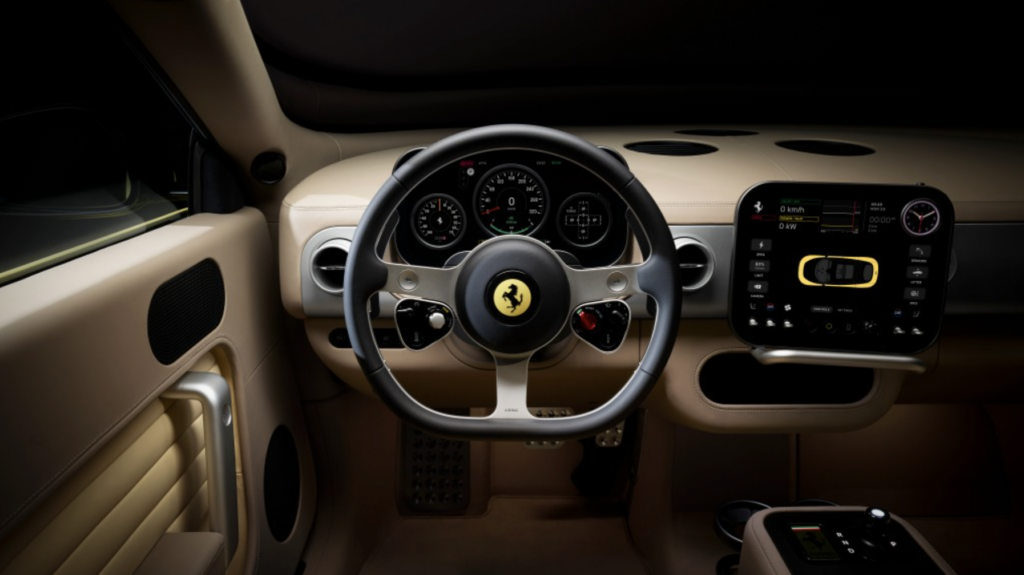
More sober assessments argued that the exterior fails to exude a sense of performance—but anyone pressing pedal to metal will put such doubts to bed. An electric motor on each wheel sees the Luce’s 2,260 kg bulk ease to 100 km/h in around 2.5 seconds, while its prodigious 122 kWh battery offers an estimated 529 km range. As to be expected from Ive, whose iPhone design remains a paradigmshifting piece of consumer tech, the interior rejects the soulless clunkiness of modern touchscreens in favour of a hyper-clean minimalist aesthetic, encouraging seamless tactile engagement with the car’s various touch-points.
The central control panel can, by means of an aluminium grab handle, pivot to suit the view of the driver or passenger—with said handle acting as a natural palm rest when operating the screen. Mounted along its bottom are a series of switches and toggles, which click pleasingly when activated. The main instrument binnacle—also a mixture of analogue and digital dials—is fixed to the steering column and, neatly, moves in unison with it.
And herein lies the Luce’s quiet genius: the way it nods to the past while embracing the future; how it rejects pure modernism in favour of both form and function. A reality faced by automotive creatives nowadays is that it’s impossible to innovate without talk of hallowed founders rotating in their resting places. But without disruptors taking massive risks, the magazine you’re reading would be far less of a repository of wonders than it is. From around €430,000
Best Ultra-Luxe Super SUV: Land Rover Defender Octa
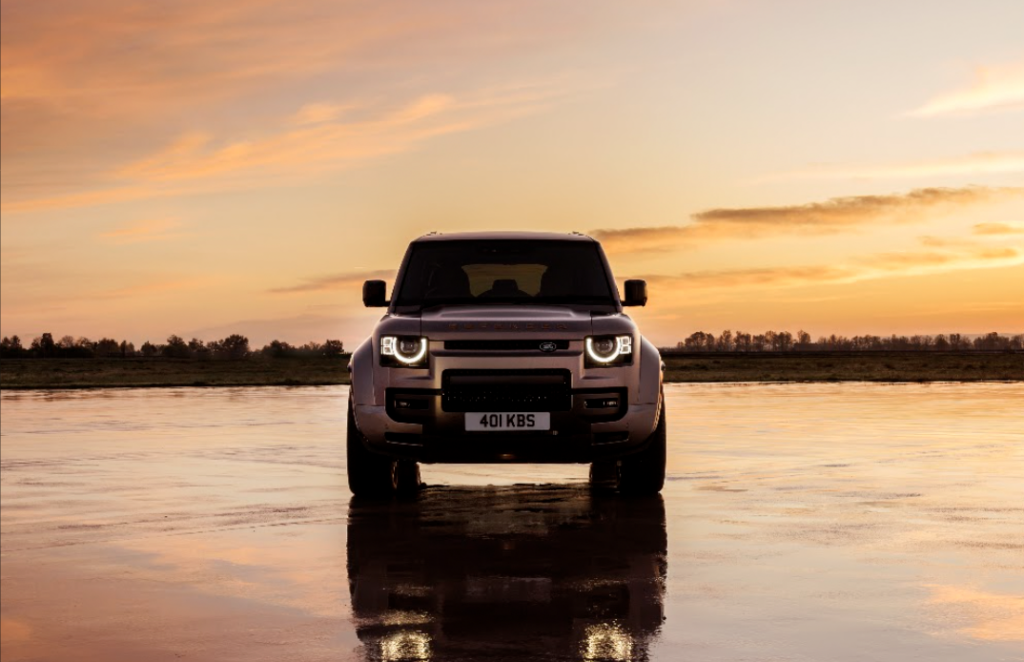
Very few Breitling Navitimers or Rolex GMT-Master IIs will ever see the inside of a cockpit, let alone play any role in a low-flying stealth mission—and yet, if called upon in a genuine military aviation scenario, they’d be fit for purpose. What’s that got to do with cars? Well, with many performance SUVs drifting ever closer to being grand tourers in disguise, the Land Rover Defender OCTA transports the driver back into that glorious Goldilocks zone where luxury and utility intersect: the fastest and most powerful production Defender ever remains true to the marque’s ultra-refined comfort ethos, but would gobble up pretty much any terrain into which you dared to steer it.
An upgraded chassis, deft active dynamics and heavily revised suspension all contribute to incredible terrain response: and yet most would rather tear up the Nürburgring than the Namib in a high-riding, near twoand- a-half-tonne beast whose 4.4-litre, twin-turbo V8, mild-hybrid engine (sourced from BMW) can propel it to 100 km/h in under 4.0 seconds.
The squared-off architecture and utilitarian-chic colourways found inside (Burnt Sienna, Ebony Semi- Aniline Leather) are soundly in keeping with the rugged-but-ravishing aesthetic that Land Rover has carefully honed ever since former CCO Gerry McGovern reframed the brand’s design language. Capability, comfort, outright pace—a holy triumvirate for this year’s winner of the ultra-luxe super SUV segment. From around €185,000
Best Grand Tourer: Bentley Supersports
“It signifies a return to Bentley making more extreme cars —ones that combine extraordinary breadth of ability with true driver engagement, while remaining pieces of automotive artwork unique and bespoke to each customer.” So proclaimed Frank-Steffen Walliser, Bentley’s CEO, when the storied marque unveiled a vehicle which celebrates the centenary of the first Bentley ‘Super Sports’, the first of its cars to break the 100 mph (approximately 160 km/h) barrier.
Just 500 examples of this rear-wheel-drive, lightweight road-shredder have been made—scheduled to begin deliveries in the final quarter of the year—and already those lucky enough to spend time in the pilot’s seat have been effusive about its capabilities. The Supersport’s turbo V8 kicks out 490 kW and 800 Nm of torque, all marshalled through an eight-speed dual-clutch gearbox, and will propel the two-and-a-half-tonne colossus to 100 km/h in little more than 3.0 seconds—and then onwards to a top speed approaching 310 km/h.
Chassis tweaks, rear-wheel steering, active anti-roll technology and sophisticated torque vectoring combine to boost agility, while the interior is replete with the diamond-quilted hides, open-pore veneers and precisely machined metalwork we all expect from Crewe’s cabin mavens. Devastatingly quick, exquisitely crafted and crackling with quiet authority, it’s everything a grand tourer should be. From around €340,000
Best Ultra-Luxury Sedan: Rolls-Royce Phantom Centenary
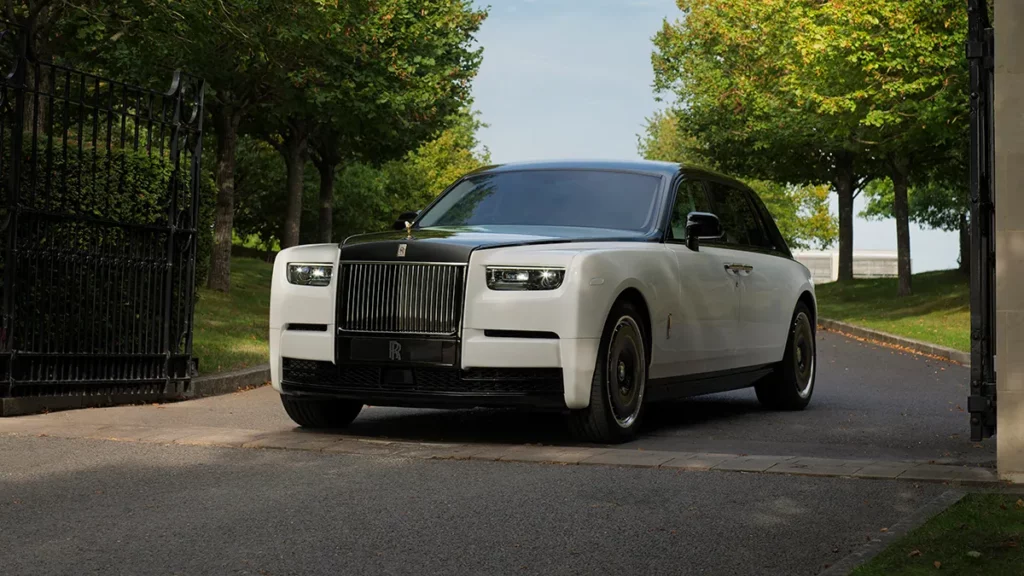
At a time when certain saloons boast hypercar-rivalling power and performance, our class winner is a roughly 2.6-tonne leviathan that reaches 100 km/h in a relatively unhurried 5.3 seconds. Why? Because sheer artistry carried the day. Limited to just 25 examples, the Rolls-Royce Phantom Centenary celebrates not only the marque’s iconic luxury sedan, first introduced in 1925, but also its enduring status as a canvas for creative expression.
The exterior alone balances gravitas and grandeur, finished in a palette of Super Champagne Crystal, Arctic White and Black, each infused with powdered glass to create a remarkable lustre. Presiding over the prow is a Spirit of Ecstasy figurine rendered in 18- and 24-kt gold. Yet it is the interior that truly captivates. Incorporating 3D marquetry, handapplied ink detailing, gold-leaf layering and laser etching, the cabin represents a formidable feat of craftsmanship. The rear compartment alone required 160,000 stitches.
Across 45 panels, the interior chronicles the Phantom’s history, from its origins and notable owners to key moments in its story, while the Starlight headliner weaves in further references. Beneath it all, a 6.75-litre, twin-turbocharged V12, paired with an eight-speed satellite-aided transmission and self-levelling air suspension, continues to deliver the marque’s ‘magic carpet ride’. Here, however, that sense of effortless progress is elevated still further by an aesthetic vision a century in the making. Pricing remains undisclosed, but commissions are rumoured to exceed €2 million