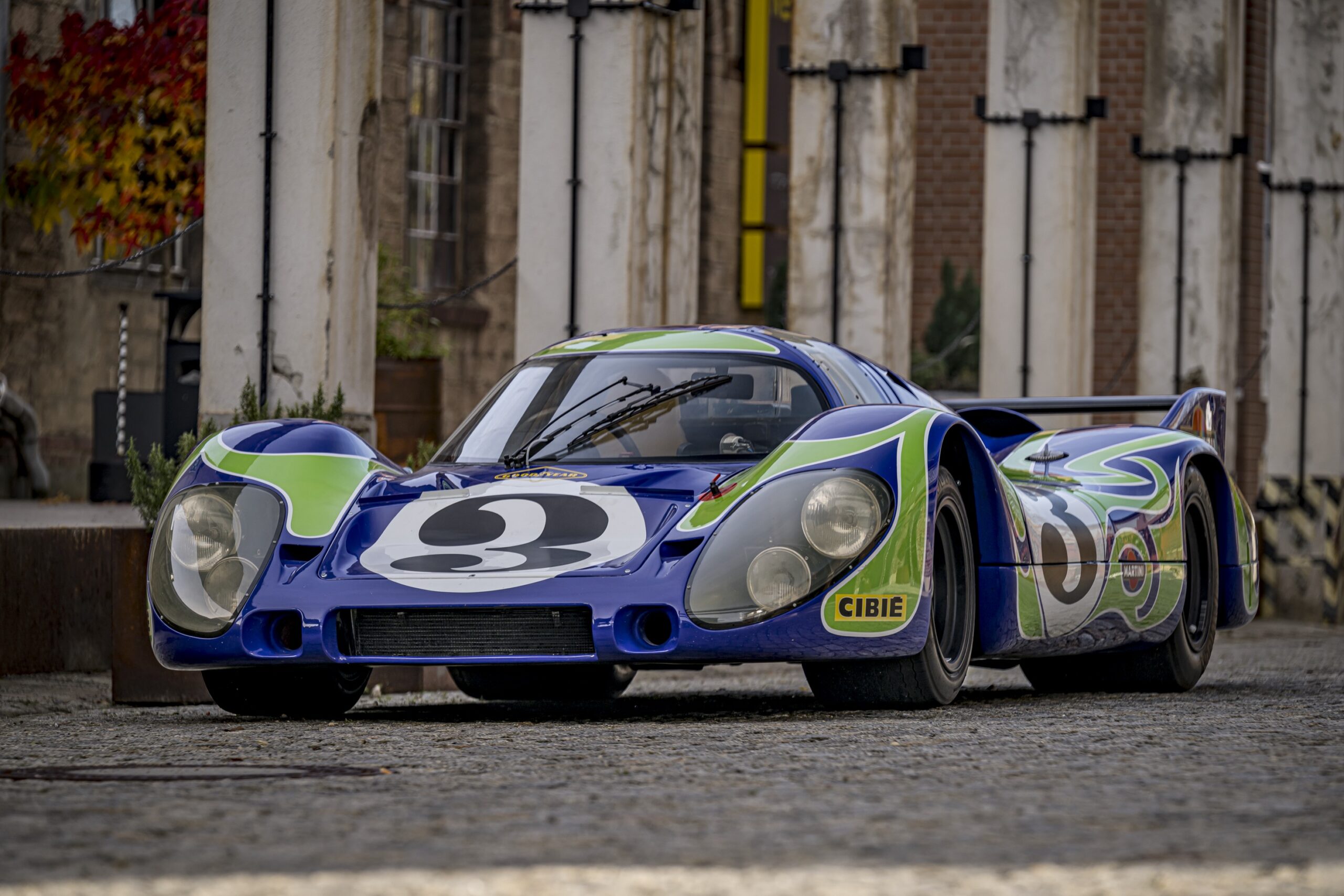
This Le Mans legend is set to make its debut up the hill at the Goodwood Festival of Speed this weekend.
In May 2022, the 1955 Mercedes-Benz 300 SLR Uhlenhaut Coupé, one of two 300SLRs ever built, stowed away in the manufacturer’s museum for six decades, sold at a private RM Sotheby’s auction for €135 million. It was the highest price ever paid for a motor car. It was also, crucially, a car that had never turned a wheel in competition.
That detail matters. The Uhlenhaut Coupé’s value was a function of desirability but also inaccessibility: it had never raced, it was locked away, and the moment someone could buy it, the mythology did the rest. The question circulating among specialists at the top end of the market ever since has been whether there is an equally significant second act. A car with the same untouchable status, but potentially one that adds to that with an unrivalled racing history. The Porsche 917-043, known the world over as the ‘Hippie Car’, is certainly a worthy candidate. The very same car that will make its debut ‘up the hill’ at the Goodwood Festival of Speed.

Frank Sytner is the car’s current custodian. The founder of the Sytner Group, one of Britain’s largest luxury car dealership businesses, which sold to Penske in 2002, he’s also spent a lifetime behind the wheel, first as the 1988 British Touring Car Champion and then as a seasoned historic racer. “The 917-043 occupies a category of its own,” he says. “The rarity, the racing record, the cultural history. There is no comparable car.”
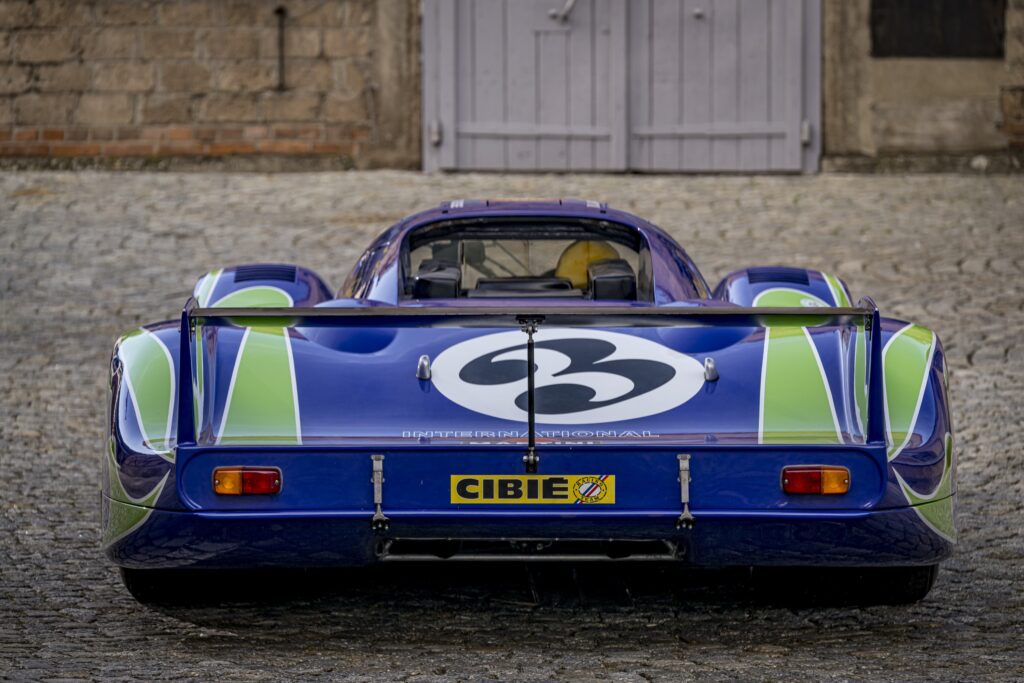
Most know the 917 in its broader form. A run of 25 cars, built for homologation in 1969 at the behest of Ferdinand Piëch, with the single objective of taking overall victory at Le Mans. Less well understood is the ‘Long Tail’ or ‘LH’ variant: five purpose-built cars that sat lower, wider and with extreme aerodynamics by the Société d’Études et de Réalisations Automobiles (SERA), with titanium and magnesium construction in the pursuit of weight saving. Where the 917K reached 350 km/h, the 917 Long Tail SERA shattered that with speeds approaching 390 km/h. Of the five chassis, only three competed at Le Mans. Two are permanently institutionalised, one at the Porsche Museum in Stuttgart, one at the Musée des 24 Heures du Mans. The third, 917-043, is in Sytner’s private collection.
As is the case with the very few truly totemic classic cars that exist, scarcity matters and the mathematics associated with 917-043 are stark. The Ferrari 250 GTO, long the benchmark for landmark classic cars, was a run of 36 examples. The McLaren F1 totalled 106. When it comes to the SERA Long Tails, there are only five, three of which raced in period and, as of today, only one – the Hippie Car – can theoretically be acquired.
Built in June 1970, the Martini-backed Porsche 917-043 arrived at Le Mans that summer without a livery. Porsche designer Anatole “Tony” Lapine painted it trackside using more than 1,500 cans of spray paint to produce its sweeping violet whorls on white. The luminous green was the final touch added the morning of the race, reportedly at the request of Count Rossi of the Martini dynasty.
The psychedelic car looked like nothing that had ever graced the Le Mans grid before and spectators soon nicknamed it “The Hippie Car,” a nod to the counterculture then in full bloom. The race that followed was one of the wettest in Le Mans history; Gérard Larrousse and Willi Kauhsen drove through torrential rain and treacherous conditions to finish second overall and win the Index of Thermal Efficiency. “It wasn’t hard to manage,” said Gérard Larrousse, recalling the car that carried him to second place in 1970. “It was extraordinary and extremely fast in the straights. You could get up to 390 km/h. Its grip was nearly perfect.”
Other than its remarkable racing result despite the conditions, it was the first ‘Art Car’ to compete in a major race, predating BMW’s celebrated programme by five years, and it also found its way onto the silver screen. That same weekend, Steve McQueen was filming at the circuit, capturing 917-043’s psychedelic livery, which is visible in the background of several sequences of the 1971 film.
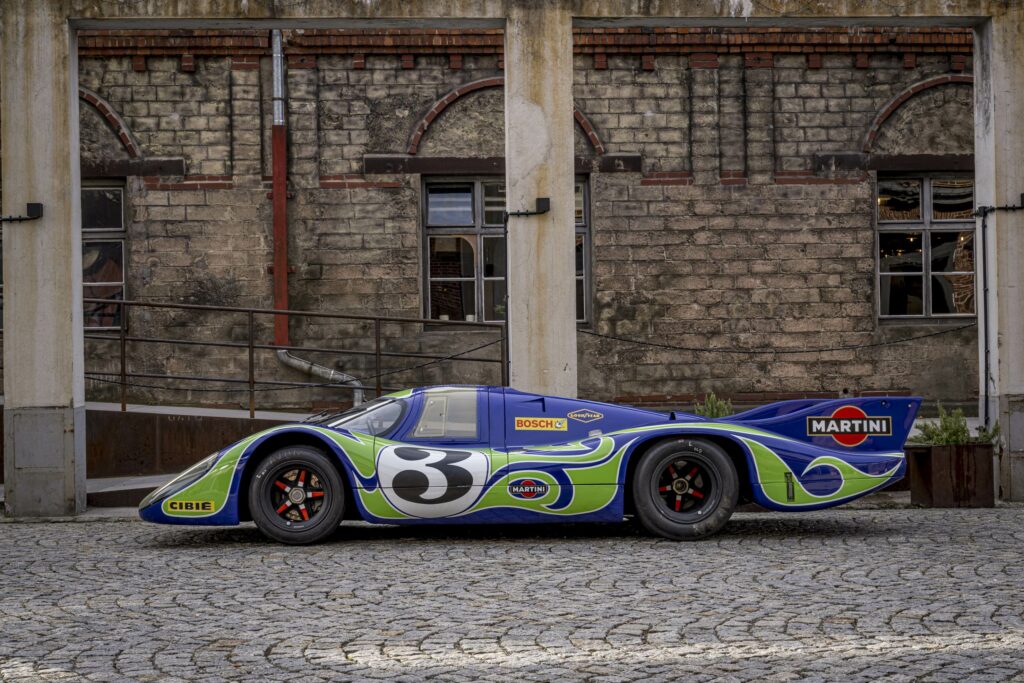
Following its 1970 Le Mans podium, the car returned, this time under the Gulf-Wyer team, driven by Jackie Oliver and Pedro Rodriguez. It set the outright Le Mans lap record: 3m 13.6s at an average speed that saw Oliver reach 386 km/h on the Mulsanne Straight, a time that still stands today. It was a record set before aerodynamic stability, telemetry and meaningful safety infrastructure, in what was one of motorsport’s most dangerous and innovative eras. The lap record was the high-water mark of a lost age of exceptional technical experimentation. Within a year, new regulations had outlawed the 917 programme entirely. “If anybody asked me what was the best car I ever drove, it was that,” says Oliver, pointing to the Porsche. “I’ve driven a lot of cars. Pedro and I won a lot of races in that car.”
Once retired, 917-043 passed through the hands of American dealer Vasek Polak before disappearing into private storage in Brazil for nearly five decades. Its sale to Sytner triggered an 18-month authentication process to clarify the racing records, drawing on Porsche factory archives, official Le Mans race records, Gulf-Wyer team papers, and the testimony of period insiders including Klaus Bischof, one of the few mechanics permitted to work on the 917s, and Norbert Singer, the Porsche engineer behind the long-tail’s aerodynamic development.
The concurrent unmasking of another Long Tail chassis, 917-044, at the Simeone Foundation Museum in Philadelphia as a misidentified substitute for the ‘Hippie Car’ only deepened the 917-043’s provenance. “A car with a race podium, a standing lap record, factory-verified documentation and a cultural moment like that livery is unique,” says Sytner.
But there is a chance that combination could become available. Sytner, now in his eighties, is contemplating the car’s next chapter. “The time has come to find another custodian,” he says, “one who can ensure it appears regularly and one who can preserve what this car represents, historically and culturally, for future generations.”
The question, until now posed quietly at the edges of concours lawns, has already been asked: Is there a car that could challenge for the top spot in the market? Consider the criteria that made the Uhlenhaut Coupé, the world’s most valuable car, and add in a racing history it never had, and the answer just might be the car wearing a psychedelic livery.